
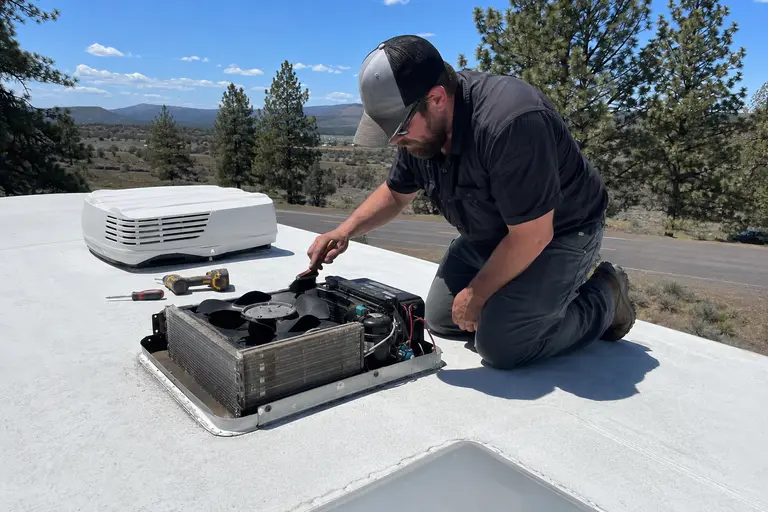
Few RV problems become urgent faster than an air conditioner that is running but not actually cooling the RV.
You can hear the fan. Air is coming through the vents. The thermostat says COOL.
But the temperature inside keeps climbing.
That does not necessarily mean the entire air conditioner has failed. Several different problems can create similar symptoms, and figuring out which one you have is important before replacing parts.
First, Is the Compressor Actually Running?
An RV air conditioner has a fan and a compressor.
The fan moves air through the RV, while the compressor is a major part of the refrigeration process that actually removes heat.
That means an air conditioner can appear to be running because the blower fan is operating even though the compressor is not.
Listen when the thermostat calls for cooling.
You may hear the fan start followed by a change in sound as the compressor starts.
If the fan runs continuously but the compressor never starts, the problem may involve the starting circuit, capacitor, control system, power supply or compressor itself.
Check the Air Coming From the Vents
Weak airflow can make an otherwise functioning air conditioner perform poorly.
Common causes include:
- dirty return-air filters
- blocked vents
- dirty evaporator coils
- restricted return airflow
- improperly positioned ductwork
- frozen evaporator coils
A badly restricted filter is one of the easiest things an RV owner can check.
Remove the return-air filter and inspect it.
If it is heavily covered with dust, pet hair or debris, clean or replace it according to the air-conditioner manufacturer's instructions.
Low Campground Voltage Can Cause AC Problems
The fact that your RV is plugged into a pedestal does not guarantee the air conditioner is receiving good power.
Campground voltage can fall when electrical demand is high, particularly during hot afternoons when many RVs are running air conditioners simultaneously.
Long or undersized extension cords and poor electrical connections can also contribute to voltage drop.
Low incoming voltage is an important issue to check before assuming the air conditioner itself has failed.
Low voltage is particularly hard on compressors because the compressor may draw additional current while struggling to start.
If you suspect campground-power problems, avoid repeatedly forcing the air conditioner to restart.
Why Does My RV AC Work Better at Night?
This is a useful diagnostic clue.
If your air conditioner keeps the RV comfortable in the evening but struggles every afternoon, several things may be happening at the same time.
Outside temperatures are higher.
Sunlight is heating the RV's roof and sidewalls.
The air conditioner has a larger heat load to overcome.
Campground voltage may also be lower because more people are using electricity.
That does not automatically mean anything is broken.
However, if an air conditioner that previously handled similar weather suddenly cannot maintain temperature, further diagnosis may be worthwhile.
Dirty Condenser Coils Can Reduce Cooling
The condenser coil is located in the rooftop portion of the air conditioner.
It needs airflow to release heat removed from inside the RV.
Dirt, debris and buildup around the condenser can reduce its ability to transfer that heat.
This is particularly relevant for RVs that spend time around:
- dusty campsites
- cottonwood trees
- pine debris
- heavy pollen
- long-term outdoor storage
Cleaning rooftop AC components needs to be done correctly because the fins can be damaged easily and the unit contains electrical components.
What About the Capacitor?
Capacitors are commonly discussed whenever an RV air conditioner will not start or cool properly.
A failed capacitor can prevent a compressor or fan motor from starting normally.
But the symptom alone does not prove the capacitor is bad.
Replacing a capacitor because somebody on the internet had the same symptom is not proper diagnosis.
Capacitors can also retain a dangerous electrical charge even after power has been removed.
Testing or replacing one should be left to someone who understands how to safely discharge and evaluate the component.
Why Does My RV AC Keep Tripping the Breaker?
A breaker that trips repeatedly is telling you something.
Possible causes can include:
- excessive electrical load
- low supply voltage
- failing compressor
- capacitor problems
- damaged wiring
- loose electrical connections
- breaker problems
- another appliance sharing available electrical capacity
Resetting a breaker repeatedly without finding out why it is tripping can turn a diagnostic clue into a larger electrical problem.
If the breaker trips again after being reset, stop repeatedly restarting the air conditioner and investigate the cause.
Could the Evaporator Coil Be Frozen?
Yes.
An evaporator coil can develop ice when airflow or operating conditions are not correct.
Symptoms may include:
- airflow getting weaker over time
- good cooling when the unit first starts
- cooling gradually decreasing
- water or ice appearing after the unit is turned off
Simply seeing ice does not tell you what caused it.
Restricted airflow is one possible cause, but other operating problems can also contribute.
What an RV Owner Can Safely Check
Before calling for service, there are several useful observations you can make without opening electrical components.
Check:
- return-air filters
- whether all vents are open
- whether airflow is strong
- whether the fan is running
- whether you can hear the compressor start
- whether the breaker has tripped
- whether the problem happens only during extremely hot afternoons
- whether another high-draw appliance was turned on when the problem started
- whether the RV is on shore power or generator power
- whether an EMS or surge protector is reporting low voltage or another electrical fault
Write these observations down.
They can significantly shorten the diagnostic process.
Don't Replace the Air Conditioner Just Yet
An RV air conditioner that blows warm air does not automatically need to be replaced.
The problem may involve airflow, incoming power, wiring, controls or a replaceable electrical component.
On the other hand, certain compressor or sealed-system failures may make replacement of the rooftop unit more economical than attempting a major repair.
The key is determining what actually failed before making that decision.
When to Have Your RV AC Diagnosed
If your RV air conditioner is running but not cooling, repeatedly trips a breaker, stops cooling after operating for a while, or has difficulty starting, a systematic diagnosis can determine whether the problem is inside the AC or somewhere else in the RV's electrical system.
Central Oregon RV Repair provides mobile RV air-conditioner and electrical troubleshooting so many problems can be diagnosed where your RV is parked.
Learn more about common symptoms on our RV Air Conditioner Repair and RV Electrical Repair pages. If your RV is near Sunriver, review our mobile RV repair in Sunriver service-area information. When you are ready, request mobile RV service and include the observations above.
Frequently Asked Questions
Can low voltage damage an RV air conditioner?
Low incoming voltage can make a compressor struggle to start and operate properly and should not be ignored.
Why is my RV AC running but only the fan works?
The blower can operate even when the compressor has not started. The starting circuit, power supply, controls and compressor are among the things that may need to be evaluated.
Should I keep resetting an RV AC breaker?
No. A breaker that repeatedly trips should be treated as a fault that needs diagnosis rather than repeatedly reset.
Why does my RV AC cool better at night?
Lower outside temperatures reduce the cooling load, and campground voltage may also be better when overall electrical demand drops.