
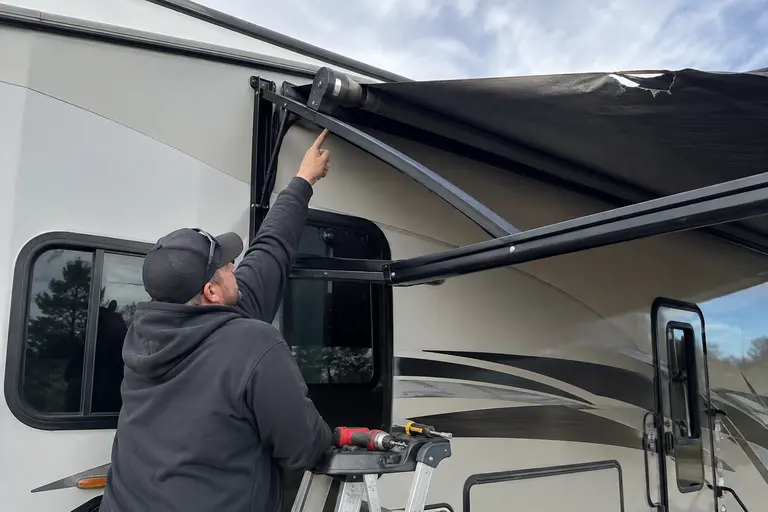
You walk back to your RV after a windy afternoon and immediately know something is wrong.
The awning fabric is hanging loose.
One arm looks crooked.
The roller tube is no longer sitting where it should.
Or maybe the awning still looks normal, but now it struggles to retract.
The first thought is usually:
Do I need an entirely new awning?
Not always.
RV awnings are assemblies made from several separate components. Depending on what the wind damaged, it may be possible to replace only the fabric, one arm assembly, the motor or another component.
The important part is determining what actually failed before ordering parts.
Wind Doesn't Always Damage Just the Fabric
A torn awning is easy to see.
What is harder to see is the mechanical damage that may have happened at the same time.
Wind places significant leverage on a fully extended awning. The force can travel through:
- the fabric
- roller tube
- lateral arms
- mounting brackets
- motor assembly
- sidewall attachment points
That means an awning with obviously torn fabric may have additional damage elsewhere.
Replacing the fabric without inspecting the rest of the assembly can leave you with a new piece of fabric installed on damaged hardware.
When Might Only the Awning Fabric Need Replacement?
Fabric-only replacement may be possible when the awning mechanism still operates correctly and the structural components remain straight and secure.
Possible fabric problems include:
- tearing
- seam separation
- UV cracking
- holes
- delamination
- worn areas near the roller
- damage along the RV awning rail
A small localized tear may sometimes be repairable, depending on the material and location.
Large tears, badly deteriorated vinyl or fabric separating along major seams usually point toward replacement instead of patching.
But before ordering fabric, the rest of the awning should be inspected.
Check Whether the Awning Arms Are Still Straight
Awning arms take a tremendous amount of stress during a wind event.
Look at the awning from several angles.
Compare the left and right sides.
Possible signs of arm damage include:
- one side sitting higher than the other
- an arm that appears bowed or twisted
- difficulty extending or retracting
- joints that no longer line up correctly
- one side reaching the RV before the other
- an arm rubbing or binding during movement
- loose or distorted mounting hardware
Do not try to force a badly bent arm back into position.
Some awning assemblies contain springs or other loaded mechanisms that can release energy unexpectedly.
Significant structural damage is better evaluated before the awning is operated again.
What About the Roller Tube?
The roller tube is the long tube the fabric wraps around when the awning retracts.
It should remain reasonably straight.
A bent roller tube can create symptoms that initially look like motor or fabric problems.
For example, the awning may:
- retract partway and stop
- require assistance to roll up
- roll the fabric unevenly
- bind at one end
- sag unusually in the center
- make the arms move unevenly
If an awning worked normally before a wind event and suddenly begins binding afterward, the tube and arms both deserve inspection.
A slight bend can have a surprisingly large effect across a long awning.
If the Awning Still Moves, Does That Mean the Motor Is Good?
Not necessarily.
A motor that moves the awning proves that the motor can produce some torque.
It does not necessarily prove that it is operating normally.
A motor may struggle because:
- the arm assembly is binding
- the roller tube is bent
- the fabric is rolling incorrectly
- battery voltage is low
- wiring has excessive voltage drop
- the motor itself is weakening
That is why replacing the motor simply because the awning stalls can lead to unnecessary parts replacement.
The mechanical load should be considered along with the electrical system.
Why Does My RV Awning Extend but Struggle to Retract?
This is a particularly useful symptom.
Gravity and awning geometry can sometimes make extending easier than retracting.
If the awning extends normally but stalls while retracting, possible causes include:
- binding arms
- bent hardware
- roller-tube distortion
- fabric tracking problems
- excessive mechanical resistance
- low 12-volt voltage
- excessive voltage drop
- weakening motor
The point where it stalls can also be useful information.
If the awning consistently stops at approximately the same position, something may be binding or loading the motor differently at that point in its travel.
Check the Mounting Points After Wind Damage
The awning does not just attach to itself.
Its brackets are attached to the RV.
A strong wind event can loosen hardware or damage the structure around those mounting locations.
Look for:
- brackets pulling away from the wall
- loose fasteners
- cracking around mounting points
- distorted brackets
- sealant separation
- movement when the arm is gently handled
If a mounting point has pulled away from the sidewall, stop operating the awning until it has been evaluated.
That becomes more than an awning problem because water intrusion and sidewall damage may also become concerns.
Don't Keep Cycling a Damaged Awning
One of the easiest ways to turn a smaller repair into a larger one is repeatedly extending and retracting an awning that is already binding.
If something is bent, each additional cycle can place stress on:
- the motor
- gearbox
- arm joints
- roller tube
- fabric
- mounting hardware
If the awning begins moving differently after wind damage, stop and determine why.
Repeatedly pressing the switch is not diagnosis.
What If the Awning Won't Retract at All?
An awning stuck open becomes an urgent problem because the RV may not be safe to move and another gust of wind can cause additional damage.
Possible causes include:
- loss of 12-volt power
- blown fuse
- motor failure
- wiring problem
- control-module issue
- bent or jammed hardware
- fabric binding
- damaged roller tube
Many awning manufacturers provide a model-specific emergency or manual retraction procedure.
The exact method varies considerably by awning.
Do not assume a manual-retraction procedure from a different awning model applies to yours.
Identify the manufacturer and model and follow the appropriate documentation.
Wind Sensors Are Helpful, but Don't Depend on Them
Some powered awnings have automatic wind-retraction systems.
They are useful, but they should not be treated as permission to leave an awning unattended.
Sensors and control systems can fail.
Wind can also arrive suddenly or from a direction that creates a large load before an automated system completely retracts the awning.
The safest habit is simple:
If you're leaving the RV, retract the awning.
That includes leaving the campground for an extended period.
What Can an RV Owner Safely Inspect?
Without disassembling loaded awning mechanisms, you can gather useful information.
Check:
- whether the fabric is torn
- whether the fabric rolls evenly
- whether both arms look straight
- whether both sides retract evenly
- whether the roller tube appears bowed
- whether brackets remain tight against the RV
- whether the motor makes noise
- whether the awning moves at all
- whether the problem occurs during both extension and retraction
- whether the awning was recently exposed to wind or pooled rainwater
- whether battery voltage is unusually low
Take photographs from both ends and from directly in front of the awning.
Those can be very useful when identifying replacement components.
Fabric, Arm, Motor or Whole Awning?
There is no single answer.
Fabric Only
This may make sense when the fabric is damaged but the tube, arms, motor and mounting hardware remain in good condition.
Arm Assembly
An individual arm assembly may be replaceable if one side was bent but the rest of the awning remains serviceable.
Motor or Drive Assembly
A motor or drive-head replacement may solve an electrical or mechanical drive failure when the rest of the assembly is undamaged.
Roller Tube
A visibly bent or mechanically distorted tube may need replacement even if the fabric remains usable.
Complete Awning Assembly
Full replacement may make more sense when several major components are damaged or when repair costs approach the cost of a replacement assembly.
The correct decision should come from inspection, not from assuming a torn awning automatically means replacing everything.
Before Ordering Parts, Identify the Awning
Do not order parts based only on the RV's year, make and model.
RV manufacturers can install different awning systems even within the same RV model year.
Look for manufacturer and model information on the awning itself.
Common RV awning manufacturers include:
- Lippert Solera
- Dometic
- Carefree of Colorado
Part identification may also require:
- awning width
- arm length
- roller-tube dimensions
- motor-head style
- fabric dimensions
- hardware numbers
Taking a few minutes to identify the actual awning can prevent ordering an expensive component that does not fit.
When to Have the Awning Professionally Inspected
Professional diagnosis is a good idea when:
- an arm is visibly bent
- the roller tube appears bowed
- the awning stalls during operation
- the motor runs but the awning barely moves
- mounting brackets have shifted
- the awning will not retract
- wind damage affected multiple components
- you're unsure whether loaded springs or mechanisms are involved
A technician can determine whether the repair requires fabric, hardware, electrical components or complete assembly replacement.
Central Oregon RV Repair provides mobile RV awning troubleshooting and repair so many awning problems can be evaluated where the RV is parked.
Learn more about common symptoms on our RV Awning Repair page. For motor, voltage, or wiring concerns, see RV Electrical Repair. If your RV is near Terrebonne, review our mobile RV repair in Terrebonne service-area information. When you are ready, request mobile RV service and include wide photos of the awning and both arms.
Frequently Asked Questions
Can RV awning fabric be replaced without replacing the whole awning?
Yes. If the arms, roller tube, drive system and mounting hardware are still serviceable, the fabric can often be replaced separately.
Can wind bend an RV awning arm?
Yes. Extended awnings can place substantial leverage on the arm assemblies during wind gusts. A bent arm should be inspected before continuing to operate the awning.
How do I know if my RV awning roller tube is bent?
Possible signs include visible bowing, uneven fabric rolling, binding, one side moving differently from the other, or the awning consistently stalling during part of its travel.
Why does my RV awning extend but not retract?
Possible causes include low voltage, wiring problems, a weakened motor, binding arms, a damaged roller tube or incorrectly tracking fabric.
Should I leave my RV awning out when I leave the campsite?
It is safer to retract the awning whenever the RV will be unattended. Weather and wind conditions can change quickly.
Can I straighten a bent RV awning arm myself?
Avoid trying to force damaged awning components back into shape without understanding the specific mechanism. Some awning systems contain loaded springs and moving components that can cause injury.