
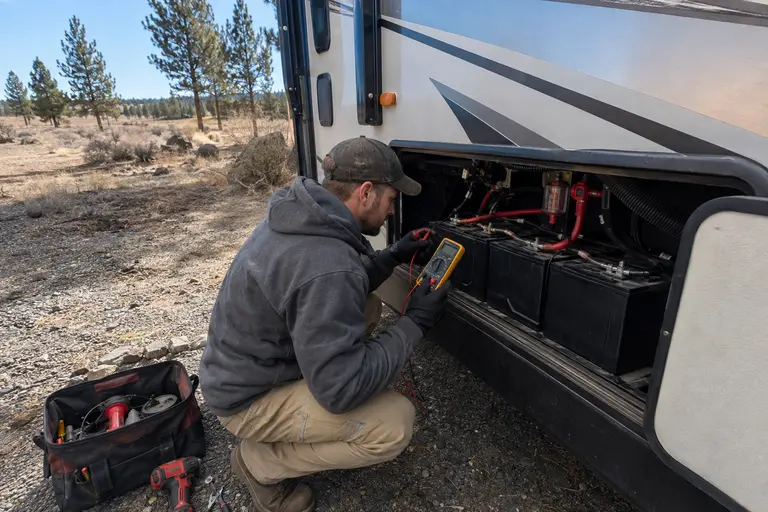
Your RV is plugged into shore power.
The lights work. The water pump works. Maybe the refrigerator and thermostat are operating normally.
But your battery monitor keeps showing the battery getting lower, or you unplug from shore power and suddenly discover the battery is nearly dead.
It is easy to assume one thing:
The converter is bad.
Sometimes it is.
But an RV can have a perfectly functioning converter and still fail to charge the battery.
Before replacing an expensive component, it helps to understand how the charging system actually works.
What Does the RV Converter Do?
Most RVs have two electrical systems:
- 120-volt AC power
- 12-volt DC power
When you're connected to shore power, the converter changes 120-volt AC power into the DC power used by many of the RV's systems.
Depending on the RV, those can include:
- interior lights
- water pump
- furnace controls
- refrigerator controls
- thermostats
- vent fans
- slides and other 12-volt equipment
The converter also normally supplies charging voltage to the house battery.
That creates an important troubleshooting clue.
If your 12-volt equipment works when you're plugged in but the battery still does not charge, the converter itself is only one possibility.
How Can the 12-Volt System Work If the Battery Isn't Charging?
This confuses a lot of RV owners.
Imagine the converter produces DC power and sends it toward both the RV's 12-volt distribution system and the battery.
If the path between the converter and battery is interrupted, the converter may still operate the lights, water pump and other 12-volt equipment while plugged in.
But the battery may receive little or no charging current.
Everything appears normal until shore power is disconnected.
Then suddenly the RV has weak or no 12-volt power because the battery was never being charged.
That is why functioning lights on shore power do not prove the battery charging system is working correctly.
Start With Battery Voltage
One of the most useful first observations is battery voltage.
With shore power disconnected and the battery at rest, note the battery voltage.
Then connect the RV to shore power and check it again after the converter has had time to begin charging.
If the converter and charging path are functioning, you would normally expect battery voltage to rise above resting battery voltage.
Exactly what voltage you see depends on:
- battery chemistry
- state of charge
- converter model
- charging stage
- temperature
- charging profile
This is especially important with lithium batteries because their normal voltage behavior differs from flooded lead-acid and AGM batteries.
The point isn't to chase one universal number.
The question is:
Is charging voltage actually reaching the battery?
Check the Battery Disconnect
The battery disconnect is an easy thing to overlook.
RV manufacturers wire disconnect systems differently. In some RVs, a disconnect can isolate the battery while allowing the converter to continue powering portions of the coach.
That can create this exact symptom:
Everything works while plugged in, but the battery doesn't charge.
The switch itself may also say ON, USE or CONNECT while another RV uses OFF, STORE or DISCONNECT.
Do not assume the switch position solely from how the label looks.
If moving the battery disconnect changes the charging behavior, that becomes an important diagnostic clue.
Look for a Fuse or DC Breaker Near the Battery
Many RVs have additional circuit protection between the battery and the rest of the 12-volt system.
This may be:
- an inline fuse
- a large fuse
- a manual-reset breaker
- an automatic-reset breaker
- a fuse or breaker mounted near the battery compartment
If that device opens, charging voltage may never reach the battery.
Because the converter may continue powering the coach while connected to shore power, this failure can easily be mistaken for a bad converter.
Don't Forget the Converter's Protection Fuses
Many converter/charger systems also include reverse-polarity or output protection fuses.
These can open after events such as incorrect battery connections or electrical faults.
The location and fuse size depend on the converter and power-center model.
If a fuse is blown, simply installing a larger fuse is not a solution.
Use only the manufacturer-specified fuse size and determine why it opened.
Wiring and Grounds Matter
Charging current has to travel from the converter to the battery and back through a complete electrical circuit.
That path may include:
- battery cables
- frame grounds
- distribution connections
- disconnect switches or solenoids
- fuses
- breakers
- terminal blocks
- splices
A loose, corroded or overheated connection can allow strange behavior.
You might have proper charging voltage at the converter but substantially different voltage at the battery.
That tells you something important:
The converter may be producing power correctly, but that power isn't making it all the way to the battery.
What If You Recently Upgraded to Lithium?
Lithium battery upgrades add another variable.
Installing a LiFePO4 battery does not automatically mean every existing charging component in the RV is optimized for it.
Older converters may have been designed primarily around lead-acid battery charging profiles.
Some modern converters offer:
- lithium mode
- selectable battery profiles
- automatic lithium detection
- manufacturer-specific charging programs
Others do not.
But converter compatibility and converter failure are two different questions.
If a lithium battery isn't charging correctly, don't automatically conclude that the converter has burned up.
First determine:
- Is the converter receiving AC power?
- Is it producing DC output?
- Is that output reaching the battery?
- Is the converter's charging profile appropriate for the installed battery?
Only then does replacing or upgrading the converter make sense.
Does a Bigger Lithium Battery Require a Bigger Converter?
Not necessarily.
A larger-capacity battery can generally accept more charging current, but that doesn't automatically mean a smaller charger will damage itself.
A lower-output compatible converter may simply take longer to recharge a large battery bank.
There are other design considerations, including:
- battery manufacturer's charging specifications
- converter output
- wiring size
- circuit protection
- expected recharge time
- other DC loads
- alternator charging
- solar charging
So don't choose converter size based only on battery capacity.
The entire charging system should be considered.
Solar Charging but Shore Power Isn't?
This is another excellent diagnostic clue.
Solar and the converter are separate charging sources in many RVs.
If your solar system successfully charges the battery but connecting the RV to shore power does not, you have already learned something valuable.
The battery is capable of receiving at least some charging current.
The problem may therefore be somewhere in the shore-power charging path.
That does not automatically condemn the converter, but it narrows the diagnosis considerably.
What Can an RV Owner Safely Check?
Without opening energized electrical equipment, you can gather several useful pieces of information:
- Does the battery charge from solar?
- Does it charge from the tow vehicle or motorhome alternator?
- Does battery voltage rise when shore power is connected?
- Does all 12-volt equipment work on shore power?
- What happens immediately after unplugging the RV?
- Is the battery disconnect in the correct position?
- Are visible battery terminals clean and tight?
- Are there accessible tripped DC breakers near the battery?
- Has the battery type recently been changed?
- Are there any error indicators on the battery monitor or converter?
Those observations can make professional diagnosis much faster.
Don't Replace the Converter Based on Symptoms Alone
Converters do fail.
But so do:
- fuses
- circuit breakers
- battery disconnects
- solenoids
- grounds
- battery cables
- wiring connections
- batteries
Replacing the converter before determining where charging voltage disappears can leave you with a new converter and exactly the same problem.
Electrical diagnosis should follow the power path.
Find where the correct voltage exists.
Then find where it stops.
When to Have the Charging System Diagnosed
If your batteries are not charging on shore power, your RV loses 12-volt power after unplugging, or your electrical system began acting differently after a lithium upgrade, systematic testing can identify whether the problem is the converter, battery, wiring, disconnect system or circuit protection.
Central Oregon RV Repair provides mobile RV electrical troubleshooting, allowing many converter, battery and 12-volt charging problems to be diagnosed at your RV.
Learn more about related symptoms on our RV Electrical Repair page. If your RV is near Bend, review our mobile RV repair in Bend service-area information. When you are ready, request mobile RV service and include the observations above.
Frequently Asked Questions
How do I know if my RV converter is charging the battery?
One useful indication is whether battery voltage rises when the RV is connected to shore power and the converter begins charging. Exact charging voltage varies depending on the battery and charging system.
Can my RV converter work but not charge the battery?
The converter may still supply the coach’s 12-volt loads while a fuse, breaker, disconnect or wiring problem prevents charging voltage from reaching the battery.
Why does my RV battery charge from solar but not shore power?
Solar and the converter are usually separate charging sources. If solar charges successfully but shore power does not, troubleshooting should concentrate on the converter and the charging path between it and the battery.
Do I need a new converter when upgrading to lithium batteries?
Possibly, but not automatically. Check the converter manufacturer’s specifications to determine whether the existing unit has an appropriate lithium charging profile.
Will a larger lithium battery burn up a smaller converter?
Battery capacity alone does not determine whether the converter is properly sized. A compatible lower-output charger may simply recharge the battery more slowly. Converter specifications, battery charging requirements, wiring and circuit protection all need to be considered.