
You turn up the thermostat.
The furnace starts.
You hear the blower running.
Then you wait for heat.
Nothing.
Maybe the fan shuts back off after 30 seconds. Maybe it keeps blowing cold air. Maybe you hear a click but never hear the burner ignite.
This is one of the most useful RV furnace symptoms because the blower running tells us something important:
The furnace has started its operating sequence, but something is preventing it from reaching or maintaining ignition.
That does not automatically mean the sail switch is bad.
It does not automatically mean the control board is bad.
And it definitely does not mean you should start replacing parts.
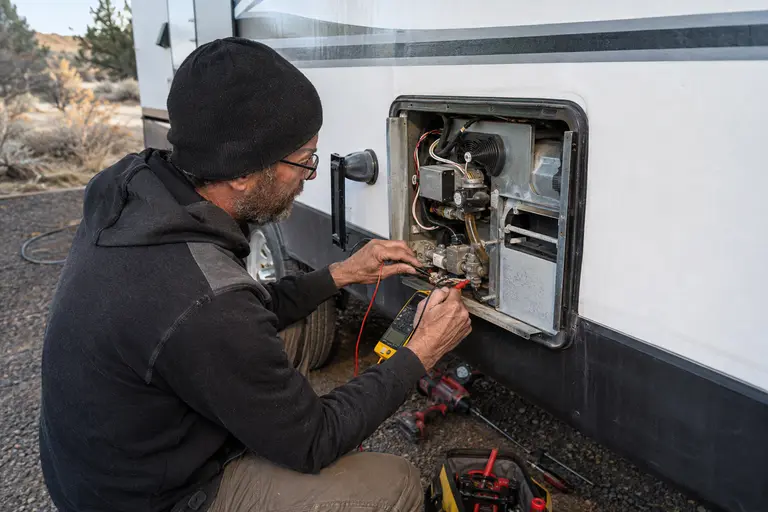
The better approach is to understand what the furnace is trying to do and determine where that sequence stops.
How an RV Furnace Starts
Most propane forced-air RV furnaces follow a sequence similar to this:
- The thermostat calls for heat.
- The blower motor starts.
- Airflow must be sufficient for the furnace's safety controls.
- The ignition sequence begins.
- The gas valve opens.
- The igniter attempts to light the propane.
- The furnace confirms that a flame is present.
- The burner continues operating until the thermostat is satisfied.
The exact design varies by furnace model, but the principle is important.
Each step has to happen before the next one can proceed.
If the furnace gets stuck at step three, replacing something from step six will not solve the problem.
If the Blower Runs, Start With 12-Volt Power
An RV furnace may burn propane, but it depends heavily on the RV's 12-volt electrical system.
The blower, control board, gas valve and ignition system all depend on adequate DC power.
That means a furnace can have plenty of propane and still fail to ignite because the battery voltage is too low.
A common mistake is checking battery voltage before the furnace starts and assuming everything is fine.
Voltage under load matters.
A battery or connection may show reasonable voltage while sitting idle and then drop significantly when the blower motor starts drawing current.
Possible clues include:
- blower sounds slower than normal
- interior lights dim when the furnace starts
- furnace works on shore power but not while boondocking
- furnace starts intermittently
- blower runs but ignition never occurs
Low voltage can also prevent the blower from reaching the airflow needed for the next safety step.
What Does the Sail Switch Actually Do?
The sail switch is one of the most commonly discussed RV furnace components.
It is an airflow-proving safety switch.
As the blower moves air through the furnace, airflow pushes against a small paddle or "sail."
When sufficient airflow exists, the switch closes.
That tells the furnace control system that the blower is moving enough air for the ignition sequence to continue.
If the sail switch does not close, the furnace should not ignite.
That is an important safety function.
A Sail-Switch Problem Doesn't Always Mean a Bad Sail Switch
This is where parts swapping gets expensive.
If the sail switch remains open, the switch itself may be faulty.
But there may also be insufficient airflow to close a perfectly good switch.
Possible causes include:
- weak blower motor
- low 12-volt voltage
- dirty blower wheel
- debris inside the furnace
- blocked return airflow
- restricted ductwork
- damaged wiring
- physical obstruction around the switch
So when somebody says, "The sail switch isn't closing," the next question should be:
Why isn't it closing?
Replacing the switch without answering that question may not solve anything.
Furnace Runs for About 30 Seconds and Shuts Off
This is another classic complaint.
The thermostat calls for heat.
The blower starts.
Approximately 20 to 30 seconds later, the furnace shuts back down without producing heat.
That timing can be a valuable diagnostic clue.
The furnace may have started its purge cycle but never received the conditions necessary to continue into ignition.
Depending on the model, possible areas to investigate include:
- airflow
- sail switch
- limit circuit
- 12-volt voltage
- wiring
- control board inputs
Do not assume the control board is bad solely because the blower stops after a predictable period.
The board may simply be doing exactly what it is supposed to do when one of the safety conditions is not satisfied.
What If You Hear a Click?
Now the sequence has likely progressed farther.
If the blower starts and you later hear a distinct click, pay attention to what happens immediately afterward.
Do you hear the rapid ticking or snapping of the igniter?
Does the burner light?
Does it light and then immediately shut off?
Each symptom points in a different direction.
Blower but No Click
The furnace may not be progressing into the ignition portion of the sequence.
Airflow, safety switches, voltage and control inputs become especially important.
Click but No Ignition Sound
The system may be attempting to energize part of the ignition circuit but not completing the sequence.
Igniter Clicks but No Flame
Now propane delivery and the ignition system become more relevant.
Burner Lights Then Goes Out
The furnace successfully reached ignition.
The problem may instead involve flame sensing, propane supply, wiring or another safety/control issue.
This is why listening to the furnace can tell you a surprising amount.
Check the Propane Supply, But Don't Stop at the Stove
If the furnace reaches the ignition stage but does not light, propane supply becomes part of the diagnosis.
One easy check is whether another propane appliance operates.
If the stove lights normally, you know propane is available somewhere in the RV's system.
But that does not prove the furnace itself is receiving the correct propane pressure or flow.
A furnace demands significantly more fuel than a small stove burner.
Possible issues can include:
- low propane supply
- regulator problems
- gas-valve problems
- obstruction at the furnace
- propane-system pressure problems
Propane pressure should be tested with proper equipment rather than guessed at by looking at the stove flame.
What About the Limit Switch?
The furnace also contains a high-temperature safety circuit.
Its job is to protect the furnace if temperatures become excessive.
If airflow through the furnace is restricted, internal temperatures can rise and activate that protection.
Possible airflow problems include:
- closed or blocked heat registers
- damaged ductwork
- restricted return-air opening
- blower problems
A limit-switch fault and an actual airflow problem can sometimes create similar symptoms.
Again, the goal should be diagnosis rather than immediately replacing the switch.
Why Does My Furnace Light and Then Shut Back Off?
A furnace that successfully ignites but cannot keep the flame going is a different problem from one that never attempts ignition.
Possible causes vary by model but may involve:
- flame-sensing circuit
- ignition electrode
- electrical connections
- propane supply
- gas valve
- control board
The ignition electrode on many RV furnaces may perform more than one job.
It can help ignite the propane and also allow the control system to verify that flame is actually present.
If the furnace does not confirm flame properly, it will shut the propane supply down as a safety measure.
Don't Bypass Furnace Safety Switches
Online troubleshooting advice sometimes recommends jumping a sail switch or other safety component.
That can be useful in controlled professional diagnostics when the manufacturer specifies an appropriate test procedure.
It should not become a permanent repair.
These switches exist to prevent the furnace from operating when conditions may be unsafe.
If a safety device prevents operation, determine why before returning the furnace to service.
Bugs and Debris Can Cause Real Furnace Problems
RV furnace exterior openings can attract insects and collect debris while the furnace sits unused.
Mud daubers and other insects are particularly good at finding places RV owners wish they wouldn't.
Debris can affect:
- burner operation
- combustion airflow
- ignition
- blower airflow
This is one reason a furnace may work perfectly in spring and then develop problems the first time it is turned on months later.
If you notice nests or obvious obstruction at an exterior furnace opening, avoid pushing tools deeply into the appliance.
The burner and combustion system should remain properly positioned and adjusted.
What Can an RV Owner Safely Check?
Before scheduling service, gather some information.
Check:
- Does the blower start?
- How long does it run?
- Does it sound strong or unusually slow?
- Do the lights dim when the blower starts?
- Do you hear a click after the blower begins?
- Do you hear the igniter?
- Does the burner ignite?
- If it ignites, how long does it stay lit?
- Do other propane appliances operate?
- Is the propane supply turned on?
- Are interior heat registers open?
- Is the return-air opening unobstructed?
- Are the furnace's exterior intake and exhaust openings visibly clear?
- Does the furnace behave differently on shore power versus battery power?
Those observations can dramatically narrow the diagnosis.
Don't Start With a Control Board
The control board is one of the more expensive components people frequently blame.
But the board depends on inputs from the rest of the furnace.
Before condemning it, diagnosis may include verifying:
- 12-volt supply
- ground
- thermostat signal
- sail-switch operation
- limit circuit
- gas-valve output
- ignition output
If the board never receives the signal showing that adequate airflow exists, it may correctly refuse to start ignition.
Installing another board will produce the same result.
The Sequence Tells the Story
When troubleshooting an RV furnace, don't begin with:
"What part commonly fails?"
Start with:
"What is the furnace actually doing?"
Blower doesn't run.
Blower runs but stops before ignition.
Igniter clicks but nothing lights.
Burner lights but immediately goes out.
Burner runs but the furnace overheats and shuts down.
Those are five different symptoms that can lead to five very different diagnostic paths.
Following the sequence is much more reliable than replacing the part most frequently mentioned online.
Test the Furnace Before You Really Need It
A furnace that has been sitting unused for months may not reveal a problem until the first cold night.
Testing it before temperatures drop gives you time to discover problems involving:
- battery voltage
- airflow
- ignition
- propane supply
- insects or debris
- thermostat operation
Turn it on long enough to verify that the blower starts, ignition occurs, warm air reaches the registers and the furnace cycles normally.
Also make sure the RV's carbon-monoxide and propane detectors are operating properly.
When to Call an RV Technician
Professional diagnosis is appropriate when:
- the blower runs but the furnace repeatedly will not ignite
- the furnace lights and immediately shuts down
- you smell propane
- you smell exhaust inside the RV
- wiring shows signs of overheating
- electrical protection repeatedly opens
- you suspect a propane-pressure problem
- a safety switch is preventing furnace operation
- you're unsure whether combustion is occurring correctly
If you smell propane or combustion exhaust inside the RV, turn the furnace off, ventilate the RV and have the system inspected before using it again.
Central Oregon RV Repair provides mobile RV furnace and electrical troubleshooting so many no-heat problems can be diagnosed where the RV is parked.
Learn more on our RV Furnace Repair page. For battery, wiring, or control-power concerns, see RV Electrical Repair. Our RV Appliance Repair page covers related propane-appliance and control issues. If your RV is near Sunriver, review our mobile RV repair in Sunriver service-area information. When you are ready, request mobile RV service and include the startup-sequence observations above.
Frequently Asked Questions
Why does my RV furnace blower run but there is no heat?
The furnace may be stopping before ignition because of insufficient airflow, low 12-volt power, a sail-switch issue, another safety-control problem, propane delivery or the ignition system.
Why does my RV furnace run for 30 seconds and shut off?
The blower may complete its initial purge period but the furnace may not receive the safety conditions necessary to continue into ignition. Airflow, voltage and the safety circuit are common areas to investigate.
Does the blower running mean my sail switch is good?
No. The blower can spin without generating enough airflow to close the sail switch.
Can a weak RV battery cause the furnace not to ignite?
Yes. The furnace relies on 12-volt power for the blower and controls. Low voltage under blower load can interfere with the startup sequence.
Why does my furnace click but not light?
If the furnace reaches the ignition sequence but no flame develops, propane delivery, the gas valve, ignition components and related controls may need diagnosis.
Should I replace the sail switch?
Not simply because the furnace blower runs without producing heat. First determine whether sufficient airflow is actually reaching the switch.
Can I bypass an RV furnace sail switch?
A furnace safety switch should not be permanently bypassed. If it is preventing operation, the underlying problem should be identified and corrected.