
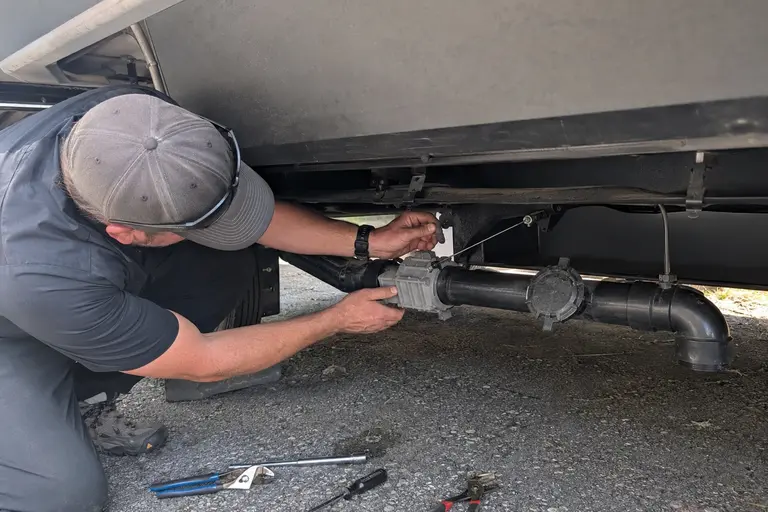
You pull the gray-tank handle.
Nothing happens.
Maybe the handle moves a little and stops.
Maybe it pulls all the way out, but the tank barely drains.
Or perhaps everything seems normal until you remove the sewer cap and discover gray water sitting behind it.
These symptoms often get lumped together as:
"My dump valve is bad."
But an RV waste valve is a small system made from several parts, and different failures can create very similar symptoms.
Before pulling harder on the handle or ordering a complete valve assembly, figure out what the valve is actually doing.
How an RV Gray Tank Valve Works
Most RV gray-water systems use a sliding gate valve.
Inside the valve body is a flat blade.
When you pull the handle, the blade slides out of the water path and allows the tank to drain.
When you push the handle back in, the blade slides between seals and closes the opening.
Some valves use a short direct-pull rod.
Others are installed farther inside the RV and use a long flexible cable connected to a remotely mounted handle.
That distinction matters.
If the handle is several feet away from the valve, you may have two completely different potential problems:
- the valve itself
- the cable operating the valve
Why Is My RV Dump Valve Hard to Pull?
A dump valve should move with reasonable resistance.
If you suddenly need both hands or a lot of force, stop.
Possible causes include:
- buildup around the valve blade
- dried or contaminated seals
- damaged valve seals
- a binding cable
- a kinked cable housing
- corrosion
- misaligned plumbing
- valve-body distortion
Gray tanks collect more than water.
They can contain:
- soap residue
- grease
- food particles
- hair
- toothpaste
- oils
- dirt
Over time, that material can build up around the valve and its seals.
Don't Yank Harder
One of the worst responses to a stiff dump valve is simply pulling harder.
Excessive force can damage:
- the plastic handle
- pull rod
- cable
- cable attachment
- valve blade
- valve housing
A valve that started out sticky can turn into a valve that will no longer operate at all.
If the handle reaches a solid stop, treat that as information.
Something is resisting movement.
Find out what before creating another problem.
Direct-Pull Valve or Cable-Operated Valve?
Look at how the handle reaches the actual valve.
Direct-Pull Valve
The handle and rod connect relatively directly to the gate.
If the handle is stiff, resistance is likely closer to the valve itself.
Cable-Operated Valve
A cable allows manufacturers to position the actual valve behind the underbelly or farther from the exterior handle.
That is convenient for packaging, but the cable becomes another mechanical component.
A cable can:
- kink
- corrode
- bind
- develop excessive bends
- stretch
- separate internally
The handle may become increasingly difficult to move even though the gate valve itself is still serviceable.
The Handle Moves, but the Valve Doesn't Fully Open
This is an especially useful symptom.
If the exterior handle moves but the gray tank does not drain normally, the cable or linkage may not be transferring the full amount of travel to the valve blade.
The handle can appear completely open while the blade is only partially open.
That can produce:
- slow tank draining
- incomplete emptying
- repeated tank-level problems
- unusual resistance
- a valve that eventually stops moving
This is why looking only at the handle can be misleading.
The important question is whether the blade itself is reaching its full open and closed positions.
Why Is There Water Behind My Sewer Cap?
You remove the termination cap and gray water comes out.
That usually means liquid got past one of the upstream holding-tank valves.
For a gray valve, possible causes include:
- debris preventing the blade from seating
- worn seals
- damaged seals
- a cable that is not pushing the valve fully closed
- valve-body distortion
- plumbing alignment putting side pressure on the valve
A small amount of residual liquid in the outlet plumbing is possible after dumping.
But if water repeatedly accumulates behind the cap, something may not be sealing correctly.
The Handle Can Be Closed While the Valve Is Still Open
Cable-operated valves create an interesting failure.
You push the exterior handle completely inward.
It looks closed.
But the valve blade itself may still be slightly open.
If the cable has excessive play or cannot complete its full travel, the handle position may no longer match the blade position.
Even a small opening can allow water to slowly leak into the common sewer outlet.
So:
Handle closed does not always mean valve fully seated.
Could the Valve Just Be Dirty?
Yes.
Gray-water residue can collect around the gate and seals.
If debris sits in the valve channel, the blade may not slide completely into its closed position.
That can explain a valve that:
- becomes progressively harder to push closed
- closes but leaks
- works better immediately after flushing
- sticks after storage
Cleaning and proper maintenance may help a healthy valve.
It will not repair torn seals or a mechanically damaged cable.
What About Lubricating the Valve?
Lubrication can help some sticking valves when the problem is friction between otherwise healthy components.
Use products intended for RV waste-valve systems and compatible with the valve seals.
Avoid spraying random petroleum-based lubricants into the plumbing system.
Some products can damage rubber components.
Lubrication should also not be used to disguise a valve that requires excessive force because something is mechanically binding.
If the problem repeatedly returns, investigate the cause.
A Cable Can Be the Problem Even If the Valve Is Fine
Remote dump-valve cables are useful, but cable routing is important.
A cable forced through sharp bends creates friction.
Over time, you may notice:
- increasing handle resistance
- handle movement that feels springy
- valve not opening completely
- valve not closing completely
- cable housing moving when the handle is pulled
In some installations, correcting the cable problem may solve the complaint without replacing the actual gate valve.
Other times, both the cable and valve have deteriorated.
Why Does My Gray Tank Drain Slowly?
A slowly draining gray tank does not automatically mean the valve has failed.
Possible causes include:
- valve not opening completely
- cable travel problem
- debris around the valve
- obstruction in the drain piping
- buildup inside the tank
- venting problems
Watch what happens when the valve opens.
Does flow begin normally and then slow down?
Or is the flow weak immediately?
Different symptoms point toward different areas of the system.
Don't Confuse a Tank Sensor Problem With a Valve Problem
RV holding-tank sensors are notorious for inaccurate readings.
Gray-water residue can cause sensors to show:
- one-third
- two-thirds
- full
even after the tank has been emptied.
If the tank drains normally but the monitor still says full, the valve may be functioning perfectly.
That becomes a sensor or tank-cleanliness problem instead of a dump-valve problem.
Diagnose the actual symptom rather than assuming the monitor-panel reading proves the tank did not empty.
What If the Tank Is Full and the Valve Won't Open?
This situation requires extra care.
A full tank means the valve and outlet are holding a significant amount of water.
Avoid removing components or loosening plumbing while the tank is full unless you have a controlled way to manage the contents.
A stuck valve with a full holding tank is often a good time to involve an RV technician.
Disassembling the wrong component can produce a very unpleasant surprise.
Does the Entire Valve Need Replacement?
Not necessarily.
Depending on the design and failure, repair may involve:
- cable replacement
- cable adjustment or rerouting
- valve seals
- valve body
- handle or linkage
- complete valve assembly
The correct repair depends on what actually failed.
Replacing the valve body will not fix a cable that binds several feet away.
Replacing the cable will not repair torn valve seals.
Identify the failure first.
What Can an RV Owner Safely Check?
Before scheduling service, gather a few observations.
Check:
- Is it the gray, black or galley valve?
- Is the handle direct-pull or cable-operated?
- Is the handle difficult to pull, push, or both?
- Does the handle move through its full travel?
- Does the tank drain quickly or slowly?
- Does water collect behind the sewer cap?
- Did the problem develop gradually or suddenly?
- Did it start after storage?
- Is the visible cable housing kinked?
- Is the valve or plumbing visibly damaged?
- Does the tank monitor still show full after a normal dump?
These answers can narrow the diagnosis quickly.
Don't Remove the Sewer Cap Carelessly
If you already suspect that a valve is leaking past, assume liquid may be trapped behind the termination cap.
Open it cautiously.
Some RV owners add a secondary twist-on gate valve at the termination point as an additional barrier.
That does not repair the failed upstream valve, but it can prevent an unexpected discharge when the cap is removed.
Preventing Dump-Valve Problems
Basic holding-tank maintenance helps reduce buildup.
Good habits include:
- using plenty of water
- avoiding grease and large food particles in the kitchen gray system
- properly flushing tanks
- operating valves periodically
- addressing increasing handle resistance early
- avoiding excessive force
- following manufacturer recommendations for valve lubrication
A valve that becomes a little harder to operate every month is giving you a warning.
It is usually easier to address that problem before the handle stops moving completely.
When to Call an RV Technician
Professional service makes sense when:
- the valve will not open
- the valve will not close
- the cable moves but the tank does not drain
- the handle requires excessive force
- wastewater repeatedly accumulates behind the sewer cap
- the cable is inaccessible behind the underbelly
- the tank is full and the valve is stuck
- plumbing must be separated to access the valve
- the valve body or piping appears damaged
An RV technician can determine whether the problem is the cable, gate, seals, plumbing alignment or another part of the waste system before unnecessary parts are replaced.
Central Oregon RV Repair provides mobile RV plumbing and holding-tank valve troubleshooting so many waste-system problems can be diagnosed where the RV is parked.
Learn more on our RV Plumbing Repair page. If your RV is near La Pine, review our mobile RV repair in La Pine service-area information. When you are ready, request mobile RV service and describe the valve type, handle travel, and drainage behavior.
Frequently Asked Questions
Why is my RV gray tank valve hard to pull?
Common possibilities include buildup around the gate, dry or worn seals, a binding cable, cable-routing problems, corrosion or valve misalignment.
Why does my RV gray tank valve leak when it is closed?
The blade may not be seating completely because of debris, worn seals, a cable problem or distortion of the valve assembly.
Can an RV dump-valve cable go bad?
Yes. Remote cables can bind, kink, corrode or develop excessive play, preventing the valve blade from completing its full travel.
Should I force a stuck RV dump valve?
No. Excessive force can break the handle, rod, cable, gate or valve body.
Why does my gray tank still say full after I dump it?
The tank-level sensors may be contaminated even though the valve and tank drained normally.
Can I replace only the cable instead of the whole dump valve?
On some systems, yes. The correct repair depends on whether the failure is actually in the cable or in the valve itself.
Why is there water behind my RV sewer cap?
One of the holding-tank valves may be leaking past its seals or not closing completely. A small amount of residual water can occur, but repeated accumulation deserves inspection.