
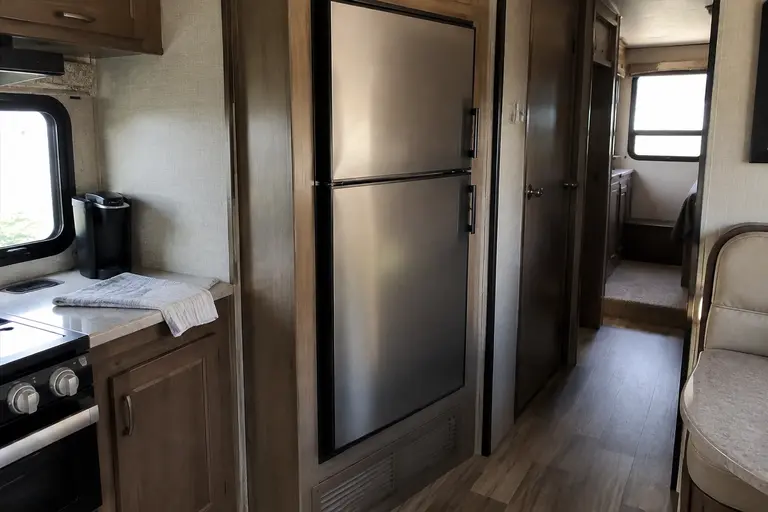
An RV refrigerator that completely stops working is frustrating. An RV refrigerator that works sometimes and then mysteriously stops cooling can be even harder to figure out.
Maybe it is cold in the morning but warm later in the day. Maybe it works while you're plugged into shore power but struggles while traveling or boondocking. Or perhaps the refrigerator light is on, but the food inside is getting warmer.
Before assuming the refrigerator itself has failed, there are several things worth understanding.
First, What Type of RV Refrigerator Do You Have?
This is one of the first questions that should be answered during diagnosis because not every RV refrigerator uses power the same way.
Depending on your RV, you may have:
- a traditional absorption refrigerator that operates on propane and 120-volt AC power
- a 12-volt compressor refrigerator
- a residential-style 120-volt refrigerator powered through shore power, a generator or an inverter
Two RVs parked next to each other can have refrigerators that look similar from inside the coach but operate very differently.
That matters when troubleshooting intermittent cooling.
The Refrigerator Light Being On Doesn't Tell the Whole Story
Seeing a light inside the refrigerator can make it seem like the refrigerator has all the power it needs.
Not necessarily.
Some refrigerators need considerably more than the small amount of electricity required to illuminate an interior light. A refrigerator may have control power while still having a problem elsewhere in the system.
That is why diagnosis needs to go beyond simply asking, "Does it have power?"
Battery Voltage Can Affect 12-Volt Refrigerators
A 12-volt compressor refrigerator relies directly on the RV's DC electrical system.
If battery voltage becomes too low, if there is excessive voltage drop in the wiring, or if a poor connection exists somewhere in the circuit, refrigerator performance can be affected.
A proper diagnosis may include checking voltage:
- at the battery
- at the distribution panel
- at the refrigerator
- while the refrigerator compressor is attempting to operate
The last measurement is important.
A circuit can sometimes show acceptable voltage with little or no load and then experience a significant voltage drop when the refrigerator tries to start.
Residential Refrigerators Need a Source of 120-Volt Power
Many larger fifth wheels and motorhomes use residential-style refrigerators.
When connected to campground shore power, supplying them is usually straightforward.
When you're away from shore power, however, the refrigerator may depend on an inverter that converts battery power into 120-volt AC power.
Turning that inverter off may also remove the refrigerator's power source.
The exact configuration depends on how the RV manufacturer designed the electrical system, so don't assume every inverter switch behaves the same way.
Solar Doesn't Usually Power the Refrigerator Directly
This is another common point of confusion.
It can be tempting to think:
Sun is shining → solar panels are producing power → refrigerator should work.
The actual path is usually more complicated.
Solar panels typically send power through a solar charge controller to the RV's battery system.
Depending on the refrigerator, power may then travel from the battery:
directly to a 12-volt refrigerator
or
through an inverter to supply a 120-volt residential refrigerator.
So having solar panels does not automatically mean there is enough energy available to keep the refrigerator operating indefinitely.
Battery capacity, solar production, other electrical loads and the refrigerator's energy consumption all matter.
Why Would an RV Refrigerator Work During Some Parts of the Day?
Intermittent refrigerator performance can have several possible causes.
They include:
- inadequate battery capacity
- low battery voltage
- voltage drop in wiring or connections
- inverter problems
- inadequate solar charging
- loss of 120-volt power
- refrigerator control problems
- poor airflow or ventilation
- high outside temperatures
- failed or intermittent fans
- temperature-sensing problems
- compressor or cooling-system problems
The symptom alone usually isn't enough to determine which one is responsible.
Heat Can Make an Existing Problem More Noticeable
RV refrigerators can have a harder job when outside temperatures rise.
This is especially important when the refrigerator is installed on the sunny side of the RV or when airflow around the refrigerator's cooling components is restricted.
If the refrigerator consistently performs better overnight and worse during the hottest part of the afternoon, that pattern is useful diagnostic information.
It does not automatically prove a ventilation problem, but it gives a technician another clue.
What Can an RV Owner Safely Check?
Before scheduling service, there are a few observations that can make diagnosis easier.
Write down:
- what type of refrigerator you have
- whether you're on shore power, generator or battery/inverter when the problem happens
- battery voltage if you have a battery monitor
- whether the refrigerator display remains on
- whether the interior light works
- any error codes
- whether the compressor or cooling fans can be heard
- whether the problem happens primarily during hot afternoons
- whether cooling returns after plugging into shore power
Those details can be much more useful than simply saying, "The refrigerator doesn't work."
Avoid Replacing Parts Based on a Guess
Intermittent problems are exactly where parts swapping can become expensive.
A refrigerator that isn't cooling properly does not automatically need:
- a new control board
- a new thermistor
- a new compressor
- a new refrigerator
Testing the electrical supply and determining what the refrigerator is actually doing when the failure occurs can narrow the problem down considerably. Learn more about the systems commonly involved on our RV Refrigerator Repair and RV Electrical Repair pages.
When It's Time for RV Refrigerator Service
If your refrigerator repeatedly loses cooling, produces an error code, experiences low voltage, or works under one power source but not another, the next step may be systematic diagnosis of the refrigerator and its supporting electrical system.
Central Oregon RV Repair provides mobile RV refrigerator and electrical troubleshooting, allowing many problems to be diagnosed at your RV instead of requiring you to take the entire rig to a dealership.
If your RV is in or near Bend, see our mobile RV repair in Bend service-area page for useful location details. When you are ready, request mobile RV service and include the observations above.
Frequently Asked Questions
Why does my RV refrigerator work on shore power but not on battery?
The answer depends on the refrigerator type. A residential refrigerator may require an inverter when shore power is unavailable, while a 12-volt refrigerator operates directly from the DC system.
Can low battery voltage cause an RV refrigerator to stop cooling?
Yes, particularly with 12-volt compressor refrigerators. Low voltage or excessive voltage drop can affect operation even when other 12-volt devices still appear to work.
Does RV solar power the refrigerator?
Usually not directly. Solar typically charges the battery bank. The battery then supplies a 12-volt refrigerator directly or supplies an inverter that powers a 120-volt refrigerator.
Why does my RV refrigerator cool better at night?
Higher daytime temperatures can increase the cooling load. If the pattern is consistent, airflow, ventilation, electrical performance and refrigerator operation are all worth evaluating.