
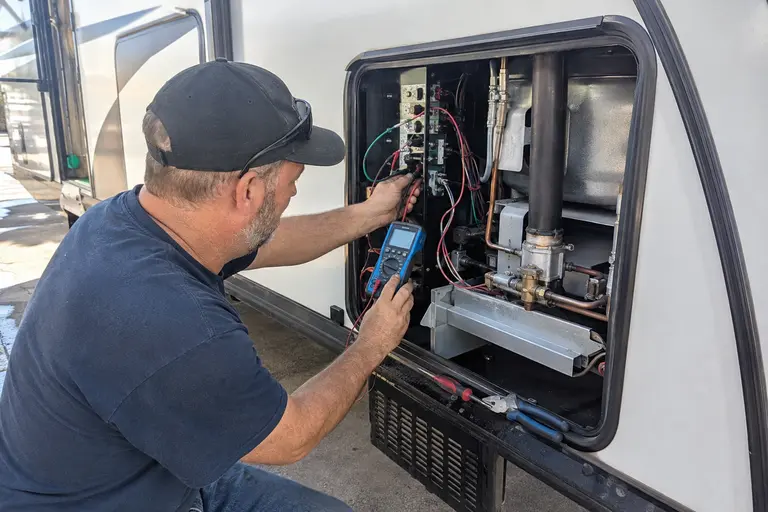
Your RV refrigerator works perfectly when you're plugged into shore power.
The freezer gets cold.
The refrigerator compartment reaches a safe temperature.
Then you switch to propane.
The freezer may still feel cold, but the refrigerator compartment starts climbing toward 45 or 50 degrees.
That symptom tells us something useful.
If an absorption refrigerator cools properly on 120-volt electric power but performs poorly on propane, the entire refrigerator is probably not "dead."
The cooling unit can still move heat.
The problem is more likely somewhere in the system that creates heat when the refrigerator is operating on propane.
That gives us a much better place to start.
Electric and Propane Use the Same Cooling Unit
A traditional RV absorption refrigerator does not use a compressor like a residential refrigerator.
Instead, it uses heat to drive a chemical absorption cycle.
That heat can usually come from one of two sources:
- a 120-volt electric heating element
- a propane flame
Both heat sources feed the same cooling unit.
So if the refrigerator performs normally on electric, that is important information.
It suggests that several major parts of the refrigeration process are capable of working.
The diagnostic question becomes:
Why isn't the propane side creating the same amount of usable heat?
The Refrigerator Still Needs 12-Volt Power on Propane
This surprises a lot of RV owners.
Even though the refrigerator is burning propane, many absorption refrigerators still require 12-volt DC power for:
- the control board
- gas valve
- ignition circuit
- display
- safety controls
Propane is the heat source.
The 12-volt system controls the appliance.
That means a low battery, bad connection, voltage drop or poor ground can create refrigerator problems even when there is plenty of propane in the tank.
Check Voltage While the Refrigerator Is Operating
A voltage reading while everything is turned off does not always tell the whole story.
A weak battery or poor connection can show acceptable voltage at rest and then drop when electrical loads are applied.
If refrigerator performance changes depending on whether the RV is connected to shore power, pay attention.
For example:
Works well on propane while plugged into shore power, but poorly when boondocking.
That can point toward the RV's battery or 12-volt supply because the converter raises system voltage when shore power is connected.
That does not prove the battery is the problem, but it is a useful diagnostic clue.
Our RV Electrical Repair page explains related battery, wiring, and control-power service.
Look at the Propane Flame
If the refrigerator successfully ignites, the next question is whether the flame is actually correct.
A normal refrigerator burner flame should generally be stable and predominantly blue.
A flame that is:
- weak
- small
- yellow or orange
- lifting away from the burner
- bouncing
- inconsistent
can indicate a problem.
Possible causes include:
- dirty burner
- debris
- restricted burner orifice
- insect nests
- propane-pressure problem
- burner misalignment
A flame can technically be present while still producing insufficient heat for proper cooling.
That is why "the fridge lit on propane" does not automatically mean the propane system is functioning correctly.
Bugs Love RV Appliance Compartments
Mud daubers, spiders and other insects can create real appliance failures.
The outside refrigerator compartment provides protected areas where insects can build nests or leave webs.
Small obstructions can affect:
- burner airflow
- propane flow
- flame pattern
- combustion
The refrigerator may continue trying to operate while cooling performance slowly deteriorates.
If you see obvious debris around the burner area, that is worth noting.
Do not enlarge or modify a propane orifice with wire, drill bits or other tools.
Propane components are precisely sized and should not be mechanically altered.
Don't Assume the Orifice Needs Replacing
A restricted burner orifice can affect flame size.
But the orifice is not the only possible cause of a weak flame.
Before replacing parts, diagnosis should consider:
- actual propane pressure
- burner condition
- air supply
- gas valve operation
- electrical control voltage
- regulator performance
Parts swapping can turn a simple cleaning or supply issue into an expensive guessing game.
Propane Pressure Matters
RV propane appliances are designed to operate within a specific pressure range.
If system pressure is too low, the refrigerator burner may not produce enough heat.
One misleading situation occurs when the stove appears to work normally.
The stove flame proves that propane is present.
It does not necessarily prove the system maintains proper pressure when multiple appliances are operating.
A refrigerator, furnace and water heater can place different demands on the propane system.
A technician can test LP system pressure using appropriate pressure-testing equipment.
That gives a real measurement instead of relying on flame appearance alone.
What If the Refrigerator Works Until Another Propane Appliance Starts?
This is an especially useful symptom.
Suppose the refrigerator cools reasonably well on propane until:
- the water heater fires
- the furnace starts
- several stove burners are used
Then refrigerator performance changes.
That may indicate an LP supply or regulator problem.
Again, the refrigerator itself may not be the root cause.
The refrigerator might simply be the appliance showing you that the system cannot maintain proper pressure under load.
See RV Appliance Repair for related propane-appliance and control-system service.
Why Can the Freezer Feel Cold While the Refrigerator Is Too Warm?
Absorption refrigerators remove heat through the freezer section first.
That means the freezer may continue to feel cold while the fresh-food compartment struggles.
An owner might see:
- freezer below freezing
- refrigerator at 45 to 55 degrees
and assume the cooling unit must be fine.
Not necessarily.
The refrigerator may be producing some cooling, but not enough total cooling capacity to maintain both compartments.
Reduced heat input from the propane burner can create this kind of partial-performance complaint.
Check the Outside Ventilation Path Too
Even if the current symptom points toward the propane side, proper refrigerator ventilation still matters.
Absorption refrigerators must release heat through the rear cooling system.
Depending on the RV installation, air typically enters through a lower exterior vent and exits through:
- an upper sidewall vent
- roof vent
Problems can include:
- debris
- blocked vents
- incorrect baffling
- failed auxiliary fan
- hot air recirculating around the refrigerator
Ventilation problems usually affect both electric and propane operation, but they can make an already weak propane-side problem more noticeable.
Hot Weather Can Magnify a Marginal Problem
Absorption refrigerators become less efficient as outside temperatures climb.
A refrigerator with a slightly weak propane flame may appear acceptable in mild weather.
Then a hot day arrives and the refrigerator compartment climbs above safe food-storage temperatures.
That does not necessarily mean the hot weather suddenly broke the refrigerator.
Heat may simply expose a system that was already operating near the edge of acceptable performance.
Don't Replace the Cooling Unit Yet
If the refrigerator performs properly on 120-volt electric mode, replacing the cooling unit should usually not be the first move.
Electric operation already provides valuable diagnostic information.
Instead, concentrate on the differences between the two modes:
Electric mode uses an electric heating element.
Propane mode uses the burner system.
The rest of the refrigeration process is largely shared.
That makes the propane heating system and its controls the logical place to investigate first.
What Can an RV Owner Safely Check?
Before scheduling service, gather some observations.
Check:
- Does the refrigerator work correctly on 120-volt electric power?
- What temperature does the refrigerator compartment reach?
- What temperature does the freezer reach?
- Does the refrigerator successfully ignite on propane?
- Is there an error code?
- Does it perform differently when connected to shore power?
- Do other propane appliances work?
- Does refrigerator performance change when another propane appliance starts?
- Is the lower exterior refrigerator vent visibly clear?
- Is there obvious debris around the burner area?
- Has the refrigerator recently worked correctly on propane?
A refrigerator thermometer can be especially useful.
"Feels warm" provides limited information.
"Freezer is 5°F and refrigerator compartment is 51°F" provides a much better starting point.
Food Safety Matters
A refrigerator that is cooling poorly is not just an inconvenience.
Perishable foods need to remain at safe temperatures.
Do not continue storing temperature-sensitive food in a refrigerator that cannot maintain a safe range.
Use a refrigerator thermometer rather than relying on how cold a shelf or beverage feels.
Don't Start With the Control Board
The control board is another component that often gets blamed prematurely.
Before replacing one, diagnosis should determine whether it is receiving appropriate:
- voltage
- ground
- operating command
- safety inputs
and whether it is properly controlling:
- ignition
- gas valve
- related outputs
If the real problem is low propane pressure or a dirty burner, a new circuit board will not improve cooling.
Follow the Symptom
The most important piece of information is still the original complaint:
The refrigerator cools normally on electric but poorly on propane.
That immediately helps narrow the problem.
Instead of asking:
"Why isn't my refrigerator cooling?"
Ask:
"What changes when I switch from electric to propane?"
That is how good diagnostics begins.
When to Call an RV Technician
Professional diagnosis is appropriate when:
- propane mode repeatedly fails to cool correctly
- the flame appears abnormal
- the refrigerator repeatedly fails to ignite
- you smell propane
- an LP fault occurs
- refrigerator performance changes when other propane appliances operate
- you suspect low propane pressure
- wiring or electrical connections appear overheated
- burner components need service
- you are unsure whether combustion is correct
If you smell propane, shut the appliance off and have the propane system inspected before continued use.
Central Oregon RV Repair provides mobile RV refrigerator and propane-appliance troubleshooting so many cooling problems can be diagnosed where the RV is parked.
Learn more on our RV Refrigerator Repair page. If your RV is near Bend, review our mobile RV repair in Bend service-area information. When you are ready, request mobile RV service and include the temperatures and operating-mode details above.
Frequently Asked Questions
Why does my RV refrigerator work on electric but not propane?
If electric operation cools properly, the cooling unit is capable of functioning. Troubleshooting can focus more heavily on the propane burner system, 12-volt controls and LP supply.
Can low battery voltage affect my RV refrigerator while running on propane?
Yes. Many propane absorption refrigerators still require 12-volt power for the control board, ignition and gas valve.
Why is my RV freezer cold but the refrigerator is 50 degrees?
The refrigerator may be producing some cooling but not enough total cooling capacity. A weak propane flame, burner problem or other heat-input issue may be contributing.
Can a dirty RV refrigerator burner cause poor cooling?
Yes. Dirt, soot, insects or other restrictions can affect flame quality and reduce the amount of heat delivered to the cooling system.
Does the stove working mean my RV propane pressure is good?
Not necessarily. It confirms that propane is available, but proper system pressure under load requires actual testing.
Should I replace the cooling unit if the refrigerator works on electric?
Not based on that symptom alone. Proper electric-mode cooling suggests the cooling unit can still operate, so the propane side should be diagnosed first.
Why does my refrigerator cool better on propane when the RV is plugged in?
One possibility is improved 12-volt system voltage from the converter while connected to shore power. Battery condition, wiring and voltage drop may need inspection.