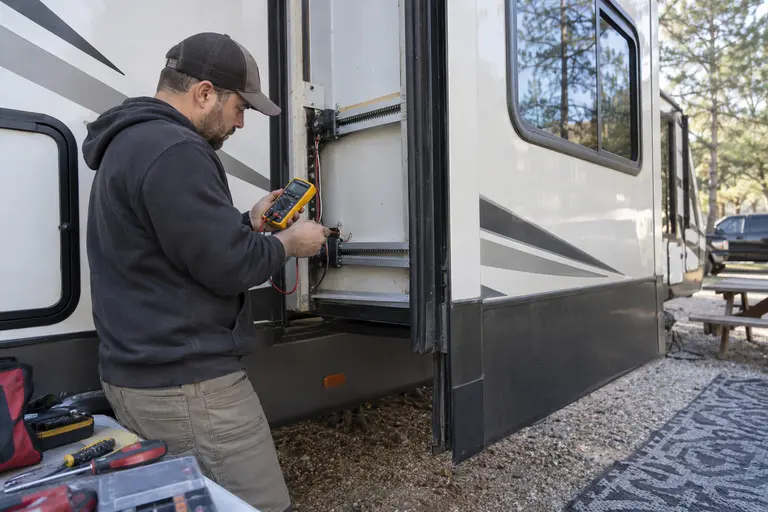
You push the slide-out switch.
Nothing happens.
Or maybe you hear a click.
Maybe the motor runs but the room barely moves.
Maybe one side comes out farther than the other.
The first question should not be:
"Which slide motor should I replace?"
It should be:
"What type of slide system is actually on this RV?"
That matters because RV manufacturers use several completely different slide mechanisms.
Two RVs can have exactly the same symptom and need completely different repairs.
Before replacing motors, controllers or gears, identify the system and then follow what the slide is actually doing.
There Isn't Just One Type of RV Slide-Out
"Slide-out" describes the room.
It does not tell you how that room moves.
Common RV slide systems include:
- Schwintek or other in-wall systems
- rack-and-pinion systems
- cable-driven systems
- hydraulic systems
Each system has its own:
- motors
- controls
- mechanical components
- failure patterns
- adjustment procedures
- emergency procedures
That is why troubleshooting advice that works perfectly on somebody else's RV can be completely wrong for yours.
How Can I Tell Which RV Slide System I Have?
You can often get a good idea with a visual inspection.
Schwintek or In-Wall Slide
Look along the vertical sides of the slide room.
A Schwintek-style system commonly has aluminum gear tracks visible along the sides of the room, usually near the upper and lower corners.
The motors are located near the upper sections of the slide mechanism.
These systems use motors on opposite sides of the room that need to work together.
Rack-and-Pinion Slide
Look underneath the slide.
You may see heavy steel rails extending beneath the room.
A toothed rack, drive shaft or gear assembly may be visible underneath the RV.
These systems mechanically drive the room in and out from below.
Cable-Driven Slide
Look around the upper and lower corners of the slide opening.
Cable systems use multiple cables and pulleys to move the room.
You may see cables running diagonally around the slide opening when the room is extended.
Hydraulic Slide
Hydraulic systems are common on larger fifth wheels and motorhomes.
Instead of individual electric motors directly driving each room, a hydraulic pump supplies pressurized fluid to cylinders that move the slide.
The same hydraulic system may also operate the RV's leveling system.
Knowing which of these systems you have changes where diagnosis starts.
Start With the Exact Symptom
Instead of saying:
"My slide doesn't work."
Describe exactly what happens.
For example:
- no sound and no movement
- click but no movement
- motor runs but room does not move
- room moves slowly
- room stops halfway
- one side moves faster
- slide makes grinding or popping noises
- slide moves normally one direction but struggles the other
- slide repeatedly trips electrical protection
Each of those symptoms provides different information.
No Sound and No Movement
Push the switch and absolutely nothing happens.
That makes the electrical side an important starting point.
Possible causes include:
- inadequate 12-volt power
- battery disconnect position
- fuse or circuit protection
- switch
- wiring
- ground connection
- controller
- motor circuit
- system-specific safety interlock
Do not assume a silent slide means the motor has failed.
The motor may never be receiving power.
Don't Forget Battery Voltage
Slide-outs can place a substantial load on an RV's 12-volt system.
A battery can show reasonable voltage while sitting idle and still have significant voltage drop when the slide tries to operate.
That creates symptoms such as:
- relay clicking
- slide beginning to move and stopping
- slow movement
- controller faults
- intermittent operation
This is why 12-volt power belongs near the beginning of slide diagnosis.
Does It Work Better on Shore Power?
That is useful information.
When connected to shore power, the converter may increase available DC system voltage.
If the slide behaves much better plugged in than it does on battery power, investigate the battery and charging system before condemning the slide motor.
It does not prove the battery is bad.
It tells you where to look next.
Our RV Electrical Repair page covers related battery, wiring, protection, and control-power concerns.
The Motor Runs but the Slide Doesn't Move
That is a very different problem.
The electrical system has apparently done enough to energize a motor or pump.
Now the question becomes whether that power is reaching the room mechanically.
Depending on the slide system, possible problems include:
- damaged gears
- failed coupler
- broken drive component
- cable problem
- hydraulic problem
- stripped mechanism
- mechanical binding
This is a good example of why you need to know which slide system you have.
"Motor runs but room doesn't move" means something different on a rack-and-pinion system than it does on a hydraulic slide.
One Side Comes Out Farther Than the Other
Stop and pay attention to this symptom.
A slide room should remain reasonably square as it moves through the opening.
If one side begins moving significantly ahead of the other, continuing to operate the room can increase the problem.
Possible causes depend heavily on the mechanism.
On an in-wall system, the two sides may no longer be moving together.
On a cable system, cable travel or adjustment may be uneven.
Mechanical damage or an obstruction can also force one side to lag.
A visibly crooked slide should not simply be cycled repeatedly in hopes that it fixes itself.
Does a Crooked Schwintek Slide Just Need to Be Re-Synced?
Sometimes an in-wall slide can lose synchronization.
There are manufacturer-defined synchronization procedures for specific systems.
But this is important:
Not every crooked Schwintek slide is simply out of sync.
Uneven travel can also be caused by:
- a weak or failed motor
- damaged gear tracks
- excessive drag
- physical obstruction
- wiring problems
- mechanical wear
- room alignment problems
If synchronization seems to correct the problem but the room immediately becomes crooked again, something may be causing the motors to lose synchronization.
Repeatedly resetting it without finding that cause is not a permanent repair.
Grinding and Popping Are Warning Sounds
A slide that suddenly begins grinding, popping or chattering is telling you something.
Stop operating it and investigate.
Possible causes include:
- gear damage
- track damage
- foreign material
- misalignment
- loose mechanical components
- excessive loading
- failing drive components
Continuing to hold the switch while gears are skipping can turn a smaller failure into a more expensive repair.
Slide Moves Partway and Stops
This symptom can have both electrical and mechanical causes.
Possible issues include:
- voltage dropping under load
- motor overheating
- increasing mechanical resistance
- obstruction
- controller fault
- damaged drive components
- uneven room movement
- cable problem
- hydraulic problem
Pay attention to whether it stops in exactly the same location every time.
If it does, inspect that portion of the travel closely.
A consistent stopping point can suggest physical resistance rather than a completely random electrical problem.
Check for the Simple Stuff First
Before assuming the mechanism has failed, visually inspect the slide.
Look for:
- objects inside blocking travel
- cabinet doors or drawers sticking into the room's path
- debris around exterior tracks
- damaged seals
- flooring lifting near the slide
- obvious bent components
- something caught underneath the room
- topper fabric bunching or binding
Do not put your hands or body into pinch points while someone operates the slide.
Slide rooms are heavy.
Treat the entire perimeter and mechanism as a pinch hazard.
Leveling Can Affect Slide Operation
Follow the RV manufacturer's instructions regarding leveling and slide operation.
Different manufacturers specify different operating sequences.
Some want the RV leveled before extending slides.
Others have model-specific instructions.
Do not assume advice from another brand applies to your RV.
An RV that is significantly twisted or improperly supported can place additional stress on a slide opening.
What About Slide Lubrication?
This is another area where generic internet advice can cause trouble.
Not every slide mechanism gets lubricated the same way.
Some components require a specific dry lubricant.
Some manufacturers recommend little or no lubricant on certain exposed mechanisms because oily products can collect dirt.
Rubber slide seals may have their own maintenance requirements.
Identify the slide system and follow the manufacturer's maintenance procedure for that system.
Do not cover every visible track with whatever lubricant happens to be in the toolbox.
Inspect the Slide Seals Too
The drive mechanism is only part of the slide system.
The room also depends on:
- wiper seals
- bulb seals
- roof seals
- lower seals
Look for:
- tears
- missing sections
- seals folding incorrectly
- hard or brittle rubber
- separation from the sidewall
- evidence of water intrusion
A drive system can work perfectly while a failed seal causes major damage somewhere else.
A Soft Slide Floor Is a Different Kind of Problem
If the room moves but the slide floor feels soft, swollen or distorted, the problem may involve water intrusion rather than the drive mechanism.
Water can enter around:
- slide seals
- exterior trim
- corners
- roof transitions
- openings or fasteners
That moisture can damage the slide floor over time.
Do not assume a dragging room automatically needs adjustment.
If the floor structure has changed shape from moisture damage, alignment may only be part of the problem.
Should You Keep Cycling a Slide That Is Acting Up?
Usually not.
If the room:
- moves crooked
- makes destructive noises
- repeatedly stops
- binds
- appears to twist
repeated operation can make the problem worse.
Cycling can be appropriate during a specific manufacturer-defined diagnostic or synchronization procedure.
That is different from repeatedly pressing the switch and hoping the problem disappears.
Don't Start With a New Motor
Motors are easy to blame because they are obvious moving components.
Before replacing one, diagnosis may include:
- battery voltage
- voltage under load
- power and ground
- switch output
- controller output
- motor current
- mechanical resistance
- slide alignment
A perfectly good motor can struggle if the room is binding.
Installing a stronger or new motor does not fix the reason the original motor was overloaded.
What Can an RV Owner Safely Check?
Before calling for service, gather this information:
- RV year, make and model
- which slide is affected
- approximate slide size
- type of slide mechanism if known
- whether the slide moves at all
- whether you hear a motor, pump or click
- whether both sides move evenly
- whether the problem occurs extending, retracting or both
- whether it works differently on shore power
- whether any grinding or popping is present
- whether anything visibly blocks the room
- whether there are controller fault lights or codes
- whether the problem started suddenly or gradually
A short video of the slide attempting to operate can also be extremely useful for diagnosis.
What About the Emergency Manual Override?
Many slide systems have a procedure for manually retracting a room if the normal drive system fails.
The procedure varies substantially by system.
A hydraulic slide is not manually retracted the same way as a Schwintek slide.
A cable system is different again.
Do not follow a generic "RV slide emergency retract" video unless you have confirmed that it applies to your exact mechanism.
Use the manufacturer's procedure for your system.
If the room is badly crooked or mechanically damaged, forcing a manual retraction can cause additional damage.
The Best Diagnostic Question
Instead of asking:
"What's wrong with my RV slide?"
Start with two questions:
What type of slide system is it?
and
Exactly what does it do when I press the switch?
Those two answers eliminate a lot of guessing.
A dead Schwintek system.
A rack-and-pinion motor that runs but does not move the room.
A hydraulic pump that runs without slide movement.
A cable room pulling unevenly.
They may all look like "a broken slide" to the owner.
They are not the same repair.
When to Call an RV Technician
Professional diagnosis is appropriate when:
- one side of the room moves differently from the other
- the room is visibly crooked
- grinding or popping occurs
- the motor runs but the room does not move
- electrical protection repeatedly trips
- the slide is stuck extended
- the room has dropped or shifted
- cables appear damaged
- hydraulic fluid is leaking
- synchronization problems repeatedly return
- the floor or structure shows water damage
- you cannot identify the system or proper emergency procedure
East Valley RV Repair provides mobile RV slide-out and electrical troubleshooting so many slide problems can be diagnosed where the RV is parked.
Learn more on our RV Slide-Out Repair page. If your RV is near Queen Creek, review our mobile RV repair in Queen Creek service-area information. When you are ready, request mobile RV service and include the mechanism type, exact symptoms, and a short video if available.
Frequently Asked Questions
Why won't my RV slide-out move?
Possible causes include low 12-volt power, electrical protection, a failed switch or controller, motor problems, mechanical binding, gears, cables or hydraulic components. The diagnostic path depends on the type of slide system.
How do I know if my RV has a Schwintek slide?
Schwintek-style in-wall systems commonly have aluminum gear tracks visible along both vertical sides of the slide room near the upper and lower corners.
Why does my RV slide click but not move?
A click indicates that part of the electrical system is responding. Low voltage under load, a motor circuit issue or mechanical resistance are possibilities that need to be separated through testing.
Why does one side of my RV slide move farther than the other?
The two sides may not be driving evenly. Possible causes include synchronization, motor, cable, track, alignment or mechanical problems depending on the slide system.
Can low battery voltage stop an RV slide?
Yes. Slide motors can draw significant current, and voltage may drop substantially when the motor is placed under load.
Should I keep running a crooked RV slide to synchronize it?
Only follow a synchronization procedure that applies to the exact system and symptom. If the room is significantly racking, binding or making destructive noises, stop operating it and diagnose the cause.
Why does my RV slide work when plugged in but not on battery?
The converter may be raising DC system voltage while connected to shore power. Battery condition, connections and voltage drop should be investigated.
Does every RV slide have the same manual override?
No. Manual retraction procedures differ between in-wall, rack-and-pinion, cable and hydraulic systems.