
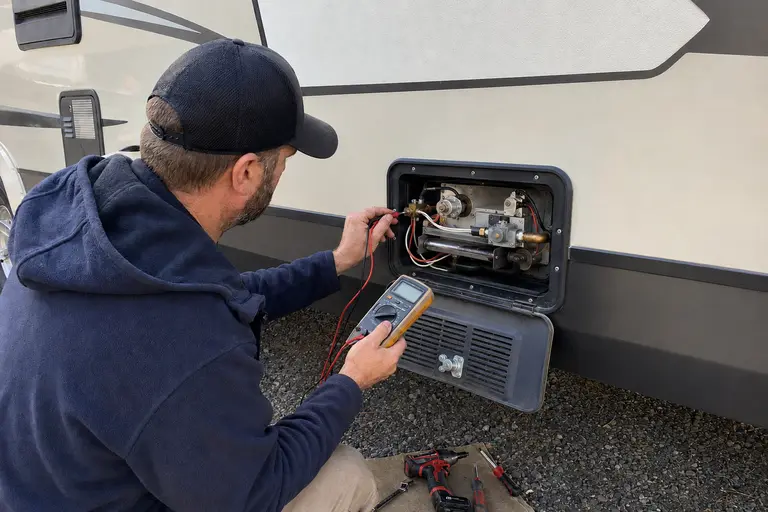
You turn on the hot-water faucet and wait.
And wait.
Still cold.
The natural reaction is to assume the RV water heater is bad.
But "no hot water" is a symptom, not a diagnosis.
Depending on the water-heater model, your RV may use propane, 120-volt electric power, or both. It may also rely on the RV's 12-volt system for controls and ignition.
That gives you several completely different ways to end up with the same complaint:
No hot water.
Before replacing a heating element, control board, igniter or entire water heater, the first step is figuring out which part of the system actually isn't working.
First, Identify Your RV Water Heater
Before troubleshooting, determine what type of water heater is installed.
Common RV configurations include:
- propane-only tank water heaters
- propane and electric tank water heaters
- tankless propane water heaters
- newer electronically controlled systems
Suburban and Dometic/Atwood are common names on tank-style RV water heaters, but model and configuration matter.
Don't order parts based only on the RV's year and model.
Identify the actual water heater installed in the RV.
Does It Fail on Propane, Electric or Both?
This is one of the most valuable questions you can answer.
If your water heater works on propane but not electric, the problem is probably different from a water heater that works on neither power source.
Likewise, if electric works perfectly but propane does not ignite, that narrows the diagnosis considerably.
So before doing anything else, determine:
Does it work on propane?
Does it work on electric?
Does neither side work?
That information can prevent a lot of unnecessary parts replacement.
If Neither Propane Nor Electric Works
When both heating methods stop working, look for something the two systems may have in common.
Depending on the model, that can include:
- 12-volt control power
- wiring
- switches
- thermostats or safety controls
- control board
- water-heater bypass configuration
A failed electric element would not normally explain why the propane burner also stopped operating.
Likewise, an empty propane tank would not explain why the electric heating element stopped producing hot water.
When both sides fail at the same time, diagnosis should look for common components before assuming two unrelated failures occurred simultaneously.
Check the Water-Heater Bypass System
An RV water heater can be operating normally while the faucets still deliver cold or lukewarm water.
How?
The plumbing may be bypassing the water heater.
RV water heaters commonly have bypass valves used during winterization.
If those valves are left in the wrong position after de-winterizing, cold water can be routed around the water heater instead of through it.
Depending on the plumbing arrangement, an incorrectly positioned valve can also allow hot and cold water to mix.
That can create complaints such as:
- no hot water
- only lukewarm water
- hot water that disappears almost immediately
Before assuming there is an appliance failure, make sure the water-heater plumbing is configured for normal use.
Why Does My RV Water Heater Work on Propane but Not Electric?
If propane operation produces hot water but the electric mode does not, you have already eliminated many possibilities.
The tank is capable of heating water.
The plumbing is likely capable of delivering that hot water.
Troubleshooting can then concentrate on the electric side of the system.
Possible causes vary by model but can include:
- no 120-volt power to the water heater
- tripped circuit breaker
- water-heater switch problem
- failed heating element
- thermostat or high-limit issue
- wiring problem
- control-system problem
One particularly important failure occurs when an electric heating element is energized without water covering it.
Heating elements are designed to transfer heat into water.
Running one dry can damage it very quickly.
That is why the water heater should be completely filled before the electric heating mode is used.
Why Does It Work on Electric but Not Propane?
Now the troubleshooting path changes.
Possible propane-side problems may include:
- no propane supply
- air in the propane line
- ignition problem
- burner contamination
- gas-valve problem
- control-board problem
- safety-circuit problem
A useful first observation is whether the water heater attempts to ignite.
When propane mode is selected, do you hear ignition clicking?
Does the burner light briefly and then shut back down?
Does absolutely nothing happen?
Those three symptoms can point in very different diagnostic directions.
The Stove Working Doesn't Prove the Water Heater Has Proper Propane Supply
RV owners often use the stove as a quick propane check.
That is useful.
If the stove burns normally, you at least know propane is present somewhere in the RV's system.
But it does not prove the water heater's own gas valve, burner or supply path is functioning properly.
So "the stove works" is a helpful clue, not a complete propane-system diagnosis.
Why Does My Water Heater Click but Not Light?
If you hear repeated clicking, the control system is likely attempting an ignition sequence.
Possible issues can include:
- propane not reaching the burner
- burner or orifice contamination
- ignition electrode problem
- electrode positioning
- wiring
- gas-valve problem
- control-board issue
Do not keep cycling the water heater repeatedly if you smell propane or suspect a gas leak.
Propane-system testing and adjustment should be performed safely with the appropriate equipment.
Why Does the Burner Light and Then Shut Off?
That is different from a water heater that never lights at all.
The appliance has successfully reached ignition, but something is preventing it from maintaining operation.
Depending on the model, diagnosis may involve the flame-sensing circuit, electrode assembly, wiring, gas supply or electronic controls.
This is a good example of why the exact sequence matters.
"Water heater doesn't work" tells a technician very little.
"Burner lights for three seconds and then shuts off" is much more useful.
Don't Automatically Replace the Control Board
Control boards get blamed for many RV appliance problems.
Sometimes correctly.
But a circuit board should usually be the conclusion of testing, not the beginning.
Before condemning a board, a technician may need to determine whether it is receiving the correct:
- 12-volt power
- ground
- thermostat or switch signal
- safety-circuit input
And then whether it is sending the proper outputs.
If the board never receives permission to ignite because another safety component has not closed, replacing the board will not fix the problem.
The RV's 12-Volt System Matters More Than Many Owners Realize
Even though the water heater is burning propane, its controls may still need 12-volt DC power.
That means low battery voltage, a blown fuse, wiring problems or poor connections can affect water-heater operation.
This surprises owners because propane is clearly available.
But modern RV appliances frequently combine multiple energy sources.
The propane creates the heat.
The 12-volt system operates the controls.
What About the Electric Heating Element?
A failed element is a common possibility when the water heater works correctly on propane but not on electric.
However, don't replace the element solely because electric mode isn't heating.
First verify that the electric side is actually receiving the power and commands it needs.
If the element does require testing or replacement, 120-volt power should be disconnected and the manufacturer's procedures followed.
Working around energized 120-volt equipment can cause serious injury.
Why Is My RV Water Only Lukewarm?
Lukewarm water can be caused by several things besides a weak water heater.
One of the most common diagnostic possibilities is cold water mixing into the hot-water system.
Possible causes include:
- bypass valves in the wrong position
- an outside shower with both faucet valves left open
- another mixing point in the plumbing
- tankless flow or temperature issues
- thermostat or heating problems
A classic RV scenario occurs when the outside shower head is shut off at the sprayer while both the hot and cold faucet handles remain open.
That can allow hot and cold water to mix inside the plumbing.
The water heater itself may be producing perfectly hot water.
What Can an RV Owner Safely Check?
Before scheduling service, gather a few observations.
Determine:
- the water-heater manufacturer and model
- whether it is tank or tankless
- whether propane mode works
- whether electric mode works
- whether either mode attempts to start
- whether you hear ignition clicking
- whether you see a fault light
- whether other propane appliances operate
- whether the 12-volt system appears normal
- whether the water heater was recently winterized
- whether bypass valves have been returned to normal
- whether the outside shower faucets are both turned off
These answers can make diagnosis significantly faster.
Stop Parts Swapping
A no-hot-water complaint does not automatically mean you need:
- an igniter
- heating element
- thermostat
- control board
- gas valve
- new water heater
Different failures can create remarkably similar symptoms.
The better approach is to follow the water heater's operating sequence and determine where that sequence stops.
That's diagnosis.
When to Call for RV Water-Heater Service
Professional diagnosis is appropriate when:
- the propane burner will not ignite
- the burner lights and repeatedly shuts down
- neither electric nor propane heating works
- electrical protection keeps tripping
- wiring shows signs of overheating
- the water heater leaks
- the tank or fittings show significant corrosion
- you smell propane
- you're unsure how the appliance's safety system operates
Central Oregon RV Repair provides mobile RV water-heater troubleshooting and repair so many problems can be diagnosed where the RV is parked.
Learn more on our RV Water Heater Repair page. For 12-volt or 120-volt concerns, see RV Electrical Repair. Our RV Appliance Repair page covers related propane-appliance and control issues. If your RV is near La Pine, review our mobile RV repair in La Pine service-area information. When you are ready, request mobile RV service and include the observations above.
Frequently Asked Questions
Why does my RV water heater work on propane but not electric?
If propane operation works normally, troubleshooting can focus on the 120-volt electric heating side, including the breaker, wiring, controls and heating element.
Why does my RV water heater work on electric but not propane?
The problem may involve propane delivery, ignition, the burner assembly, gas valve, safety circuit or controls.
Why is my RV water heater clicking but not lighting?
Clicking usually indicates an ignition attempt. If the burner doesn’t light, propane delivery, the ignition electrode, burner components and control system may need evaluation.
Can the RV water-heater bypass valve cause no hot water?
Yes. Incorrect bypass-valve positioning can route water around the tank or cause hot and cold water to mix.
Why is my RV hot water only lukewarm?
Cold-water mixing is one possibility. Check bypass plumbing and make sure outside-shower hot and cold faucets aren’t both left open with only the shower head shut off.
Should I replace the RV water-heater control board?
Not based on symptoms alone. The board should generally be tested along with its power, ground, inputs, safety circuits and outputs before being condemned.