
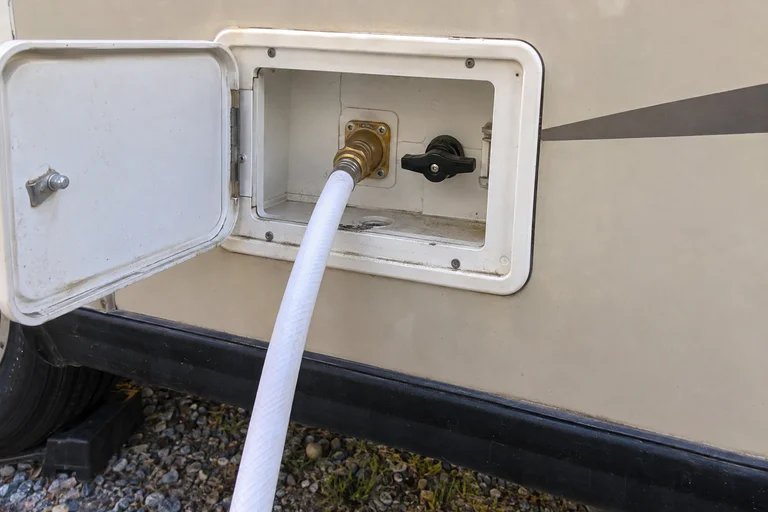
You connected the RV to city water so the campground supply would feed the faucets. Hours later, the fresh-water gauge reads higher than before, or water is coming out near the tank overflow. The pump switch is off. How is the tank still filling?
Turning the pump off stops its motor. It doesn't physically disconnect the plumbing. If city water has an unintended route into the tank, incoming pressure can move water along that route without the pump running.
Shut off the supply before chasing the cause
If the tank is overflowing or you find an active leak, turn off the campground water supply and leave the pump off. Keep clear of wet electrical equipment. Don't leave the hose supplying water while you leave the campsite to buy parts.
Never plug a vent or overflow tube to stop the water. Jayco's fresh-water system instructions warn that obstructing those tubes can damage the plumbing. A fresh-water tank isn't a pressure vessel to seal shut.
Photograph where the water first appears from a safe standing position. A drip beneath the RV doesn't identify its source. Don't crawl under an RV supported by leveling jacks, remove tank supports, or open pressurized connections.
Confirm the symptom and the selected water mode
Record the tank reading you noticed before and after connecting. One changed gauge segment is less conclusive than a repeated rise accompanied by water at an identified overflow. Don't deliberately overfill the tank to prove it.
Some RVs have a separate gravity-fill opening. Others use the same hose connection for city supply and tank filling, with valves selecting the destination. Read your own utility-panel diagram and owner's manual. Handle positions from a different floorplan aren't a reliable guide.
If a tank-fill setting was selected, water entering the tank may be exactly what that setting commands. Follow the manufacturer's normal procedure for changing modes, including shutting off the supply or relieving pressure when required. Don't force a stiff handle.
There are two paths worth separating
Water passing back through the pump
The tank normally supplies the pump, which supplies the fixtures. A check valve prevents reverse flow in the installed system. If that seal doesn't hold, city pressure can push water toward the tank instead.
Pentair's Shurflo 4008 manual specifically connects valve leak-back with a tank filling on city water. That supports checking this path; it doesn't establish that every RV with this symptom needs a complete new pump.
Normal faucet flow on pump power doesn't clear the check valve. Moving water forward and preventing backward flow are different functions. Describe both observations when arranging service.
Water crossing a fill or selector valve
Where a city-water/tank-fill valve is installed, it provides another possible route. A handle pointing to the correct setting tells you what was selected, not whether the valve seals internally. Pentair's pump troubleshooting guide includes a faulty city-water/tank-fill three-way valve among the conditions to investigate.
This is why the plumbing layout comes before the parts order. Replacing a pump can't repair a separate fill valve that passes water. Likewise, replacing a selector valve won't correct reverse leakage elsewhere.
Useful observations don't require dismantling anything
- Record the RV model, pump model, utility-panel settings, and whether the pump was switched off.
- Note whether the problem began after winterization, valve operation, pump replacement, or other plumbing work.
- Describe whether the tank rises only with city water connected, and whether faucets work normally from the tank.
- Send photos of the panel and any accessible wet area without removing covers or fittings.
If the separate symptom is a pump that briefly starts with every faucet closed, our guide to unexplained pump cycling covers that investigation. The symptoms can share a sealing fault, but one doesn't prove the cause of the other.
What the technician needs to establish
The next step is to trace the installed water paths and establish which one admits water to the tank in city mode. That requires a controlled test appropriate to the valve and pump, with pressure safely relieved before connections are disturbed. It isn't a reason to loosen a line and see what sprays out.
The repair should follow that finding. Depending on the equipment, it may involve a serviceable valve component or a larger assembly. Avoid adding a generic check valve or adjusting the pump's pressure controls before the actual route is identified.
Can you use tank water while waiting for service?
With city water shut off, using the onboard supply may be practical if the RV's normal tank-water mode works, the water is safe to use, and there are no active leaks or damaged components. Follow your RV's operating instructions and supervise use. Stop if water appears where it shouldn't. This limits the incoming supply; it doesn't establish that the fault is repaired.
For mobile RV plumbing repair, the most useful description is specific: the tank fills in city mode with the pump off, rather than simply saying the pump is bad. Request service with your location, RV details, and panel photos so diagnosis can start with the actual water path.