
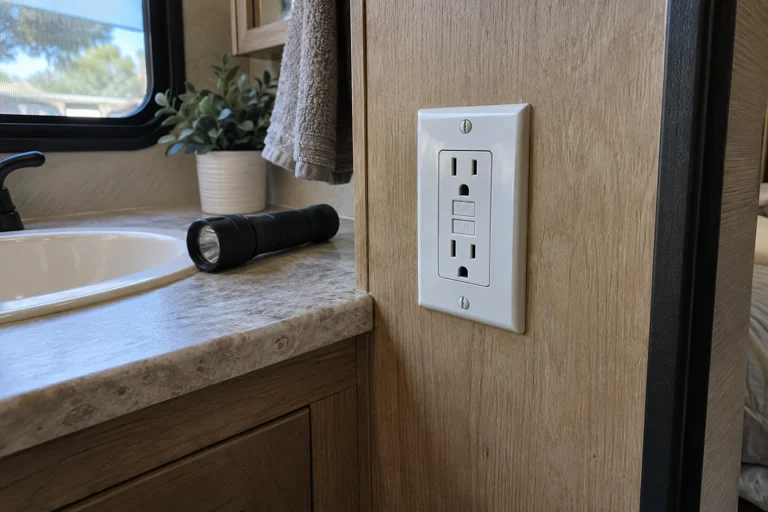
The bathroom outlet is dead, the kitchen receptacle stopped working too, and pressing RESET doesn't bring either one back. Meanwhile, the ceiling lights still work. That combination is useful information, but it doesn't prove the GFCI needs replacing.
A GFCI, or ground-fault circuit interrupter, interrupts power when it detects current taking an unintended path. Its job is shock protection. A conventional circuit breaker addresses overcurrent, so a GFCI can trip without the branch breaker tripping. Combination protective devices have additional functions; identify which device actually opened.
Start with two separate questions: is power reaching this circuit, and is something preventing the protection from resetting? Treating both as a bad outlet skips the diagnosis.
Stop here if there is water, heat, or damage
Do not touch or reset a wet, scorched, cracked, buzzing, or visibly damaged receptacle. Keep people away from wet electrical equipment. If you feel tingling from the RV or an appliance, stop using the electrical system and arrange professional help. Smoke or fire calls for getting everyone clear and contacting emergency services.
This guide covers observations and normal controls on intact, dry equipment. It does not cover removing outlet covers, opening electrical panels, probing terminals, or changing wiring. Unplugging shore power alone does not establish that an inverter-equipped RV is de-energized.
Find out how much of the RV lost power
Make a short list of outlets and appliances you already know are affected. One GFCI can protect additional receptacles connected downstream, including receptacles without TEST and RESET buttons. A bathroom device can therefore explain a dead outlet in another area. Physical distance does not establish the wiring order.
Look for the actual protective device using your RV's manual and circuit labels. Do not assume every floorplan puts it in the same cabinet or that the RV has only one. Leviton's GFCI protection overview explains both downstream protection and the distinction from ordinary overcurrent protection.
Working ceiling lights don't prove the receptacle has AC power. Many RV lights operate from the battery-backed DC system. If unrelated AC equipment is also dead, investigate the supply situation before focusing on one outlet.
A GFCI can refuse to reset because it has no incoming power
Modern reset-lockout designs need the correct incoming supply before they can restore power. Leviton's reset-lockout guidance identifies missing power, an ongoing fault, incorrect wiring, and device damage as different reasons a reset may fail.
Note whether you are connected to shore power, running a generator, or expecting an inverter to supply the outlets. Read accessible power-management or inverter displays and record the exact message. A connected cord is not proof that power is being delivered through every part of the RV.
Inverter operation depends on the installed equipment, its settings, and which circuits it supplies. For example, the KISAE BIC manual describes operating modes that differ in whether inverter power starts automatically after incoming AC is lost. Don't apply another owner's setting to a different installation.
With covers intact and everything dry, you can observe labeled breaker positions and follow your RV manual's normal operating instructions. Do not repeatedly reset a breaker that opens again, or open a pedestal or panel to look for power. Report a suspected campground-supply problem to campground staff.
Separate a connected appliance from the circuit itself
If there are no warning signs, switch off and unplug accessible portable appliances from the affected outlets, including downstream outlets you have identified. Leave installed equipment and inaccessible plugs to the technician. Switching an appliance off is not always equivalent to unplugging it.
Then follow the GFCI manufacturer's reset instructions once. If it holds after those items are unplugged, that narrows the investigation toward the disconnected equipment or its cords. It does not identify which item failed, and it is not a reason to move a suspect appliance to an unprotected outlet.
If it immediately trips again, leave the affected circuit out of use. Repeatedly pressing RESET only repeats the symptom. If it still won't reset with accessible appliances unplugged, the remaining possibilities include missing supply, connected wiring or equipment you haven't isolated, and the GFCI itself.
What changed before the first failure?
It started after rain or a plumbing leak
Tell the technician about the timing even if the bathroom outlet looks dry. The protected circuit can extend elsewhere. Do not assume that drying enough to reset means water-damaged equipment is safe to reuse. The moisture source and affected electrical components both need attention.
It started immediately after an outlet was replaced
A new device is not automatically a good installation. Leviton's line/load reversal guidance identifies reversed incoming and downstream connections as a cause of failed operation. That is a reason to have the installation checked, not an instruction to swap wires yourself.
It works on shore power but not on the inverter
That comparison makes the power path relevant. Record the already-observed difference and any inverter warning. Don't keep changing sources to make protection hold. A technician needs to establish whether the outlet is actually supplied in each mode and whether the installed equipment is compatible.
What a proper diagnosis should answer
Professional testing should establish the incoming supply at the protective device, distinguish the device from its downstream circuit, and identify any connected load involved. The technician must account for all power sources and follow the equipment's isolation procedures. These are not live-terminal owner checks.
A replacement is justified when testing shows the device cannot operate or protect correctly, not merely because several outlets are dead. Never bypass GFCI protection, remove a grounding pin, or increase a fuse or breaker rating to keep equipment running.
Our mobile RV electrical repair service covers dead outlets, inverter concerns, and protective devices that keep opening. If the separate complaint is a battery that will not charge while plugged in, follow our shore-power charging diagnosis instead of assuming both symptoms have the same cause.
Two common questions before service
Does a green light prove the GFCI is working?
Read the instructions for that exact device. Indicator meanings vary with model and button position. Leviton's model-specific indicator charts show why color alone is not enough. A lamp turning on also does not prove that ground-fault protection passes its prescribed test.
What should I send with a service request?
Include the RV year and model, the affected outlets, power source, visible indicator status, and what happened immediately before the failure. Note any water exposure or recent electrical work. Request mobile RV service with your location and those observations so the next step can be planned around the actual symptom.