
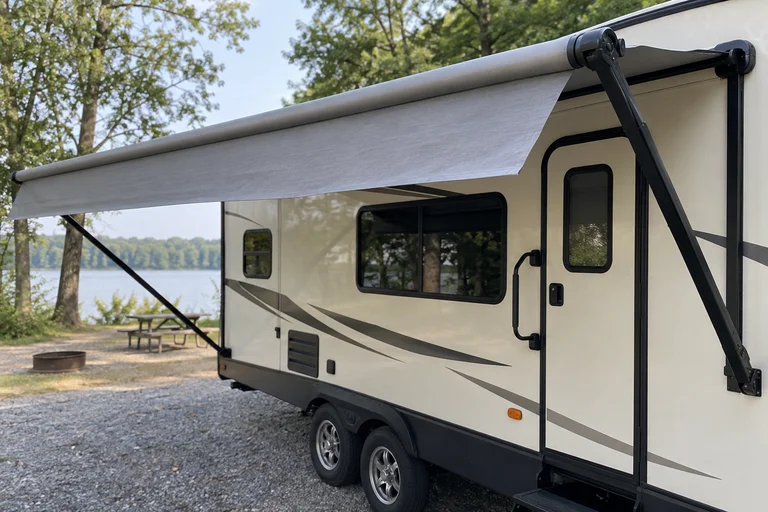
The awning extended normally, but now the retract control does nothing. Or you hear the motor while the fabric barely moves. Those are different symptoms, and neither one proves you need a new awning.
Before trying another switch press, look at the assembly from a safe distance. Is the roller straight? Are both arms aligned? Is fabric bunching at one end? The first decision is whether normal operation is safe, not which part to order.
Stop if the assembly is crooked, loaded, or moving unpredictably
Keep people clear if an arm is bent, a bracket has shifted, fabric holds pooled water, or the awning is moving in wind. Don't stand beneath it, push on a loaded arm, or release mounting hardware. Repeatedly powering a binding assembly can turn a repairable problem into more damage.
Don't drive with the awning partly extended or unsecured. If weather is worsening and it won't close, request help promptly and keep clear of its movement area. A towel, rope, or guessed release procedure isn't a substitute for securing the system correctly.
If the problem followed a gust or impact, our awning wind-damage guide addresses damaged fabric, arms, and mounting points. The checks below concern a power awning without an obvious structural failure.
No sound: establish whether the command reaches the system
Record which control you used: wall switch, remote, exterior panel, or app. If another normal control already operates the awning, that comparison narrows the investigation toward the command path. It doesn't justify bypassing a control or safety feature.
Check the exact operating instructions for enable switches, locks, and required conditions. For example, Airstream's powered-awning guidance describes a control-panel unlock step for certain Classic installations. That is an example of model dependence, not a button sequence for every RV.
Note whether other battery-powered equipment works and what the accessible battery display shows. Working lights don't establish that the awning's own supply, wiring, and controls can deliver power to its motor. A quiet motor can result from no command, an interrupted supply, or a fault at the motor; sound alone doesn't choose between them.
Motor noise without normal movement changes the investigation
If the motor runs but the roller doesn't follow, the mechanical drive deserves inspection. If one end moves while the other binds, stop operating it. Don't try to help by pulling an arm while someone holds the switch.
A click is less conclusive than a motor clearly turning. Tell the technician what you actually heard and whether any part moved. A short video from outside the movement area is useful if you already captured it; don't reproduce a dangerous fault just to get footage.
A slow retract also needs context. Compare it with this awning's previous behavior, not another camper's travel time. A motor pulling a load, a poor electrical connection, and a mechanical restriction can all produce disappointing movement for different reasons.
Why a technician checks power under the operating condition
Carefree's Travel'R service manual separates installation integrity, power supply, motor function, and wiring checks. That sequence helps avoid replacing a motor when the problem lies upstream.
The useful electrical question is what reaches the drive when it is asked to move. A battery reading taken with everything idle doesn't answer that. A technician can test the installed circuit and compare findings with the correct manual, while accounting for the mechanical load.
Do not open controls, connect a drill battery to wires, increase fuse size, or repeatedly reset protection to keep the awning moving. Those actions can bypass normal control and create unexpected movement. Owner checks here are limited to normal controls, visible condition, and documented user-accessible items.
Manual retraction is not one universal procedure
Identify the awning itself before attempting emergency operation. The RV year and model aren't enough if equipment has changed. Lippert's Solera 3000 support page lists a specific owner's manual for versions without a manual override, alongside other manuals. A generic claim that every power awning has the same override is therefore unsafe.
Even where an emergency method exists, the drive arrangement, direction, access, and securing steps matter. Use only the instructions for the installed model. If identification is uncertain, access requires unsafe ladder placement, or the assembly is damaged, leave retraction to a technician.
What to send before service
- Awning manufacturer and model, if readable safely.
- Which control was used and whether another normal control behaved differently.
- Silence, clicking, motor rotation, partial travel, or uneven movement.
- Wide photos of both arms, the roller, and the mounting area.
- Recent weather, impact, battery changes, or work on the awning.
Include whether the RV must move soon and whether the awning is fully extended or partway closed. That helps plan access and safe securing before parts are ordered.
Our mobile RV awning repair service covers failure to retract and uneven operation. If the findings point to the supply or controls, RV electrical diagnosis may be part of the repair. Request service with your location and the observations above.