
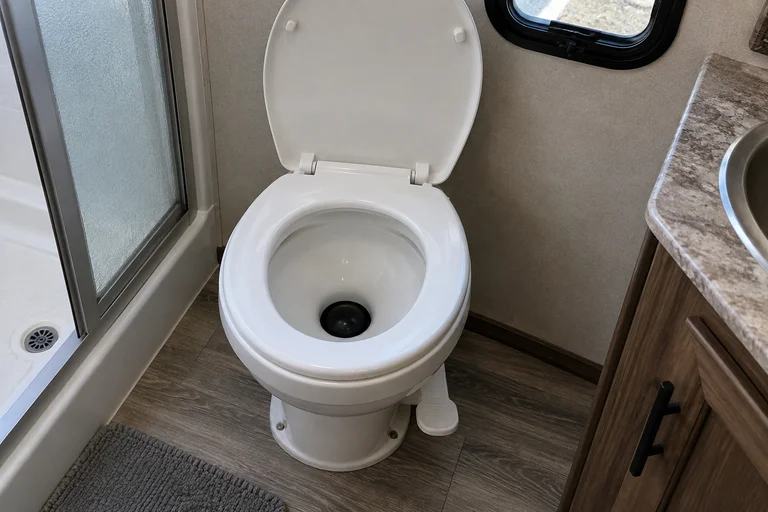
You flush, leave water in the RV toilet bowl, and come back to find it nearly dry. There isn't a puddle on the floor. Before ordering a water valve or replacing the toilet, separate water that never entered the bowl from water that entered and then escaped.
This guide concerns gravity-flush RV toilets with a ball or blade closing the opening beneath the bowl. Electric macerating, vacuum, and cassette toilets have different mechanisms and service procedures. Find the model label before applying a fix from another owner's RV.
Watch what happens after the flush
Use the toilet's normal water-add control as described in its manual. Release the control fully, then observe without flushing again. Note whether water accumulates initially and whether its level falls over the next few minutes. A quick phone photo before and after is more useful than guessing how much disappeared.
If little or no water enters, investigate the supply and water-add operation. If water enters but won't stay, investigate the closed outlet and its seal. If water continues entering after the control is released, that's a third symptom: failure to stop incoming flow. These observations lead to different repairs.
Don't leave a toilet with uncontrolled incoming water unattended. Shut off the pump and city-water supply if connected. A bowl that is slowly filling can become an overflow problem.
A dry floor doesn't mean there is no leak
On a gravity toilet, water can pass through the bottom opening into the holding tank without ever reaching the bathroom floor. The useful question is where the water goes, not whether the carpet feels dry.
A wet base needs a separate inspection. Thetford's permanent-toilet instructions distinguish supply connections and the floor flange when tracing external leakage. Replacing the bowl seal isn't a substitute for locating water around the toilet.
If the floor is wet, the base moves, or wastewater is present, stop using the toilet and arrange service. Don't tighten mounting hardware blindly. Record where moisture first appears and keep children and pets away from the area.
Check closure before condemning the seal
Observe the ball or blade from above while using the normal control. It should return to its normal closed position when released. Don't force the pedal, pry the mechanism, or put fingers into the opening. A mechanism that doesn't return fully deserves attention before a new seal is installed.
For the listed Dometic gravity models, the 300/310/320 series manual identifies dirt, seal positioning, temporary distortion, and wear as separate reasons water won't stay in the bowl. It also explains that deposits at the sealing surface can produce a slow leak.
That supports starting with the manufacturer's cleaning procedure for the exact toilet. Use only compatible cleaning products and tools, follow hygiene precautions, and avoid scraping with a screwdriver or adding a household chemical mixture. Leave any procedure you can't perform safely to a technician.
What the result tells you
If correct cleaning restores water retention, contamination was affecting the seal. Watch whether the improvement lasts. A recurring problem calls for checking the surface condition and closure rather than repeatedly adding treatment and assuming the repair is finished.
If water still disappears, the technician should inspect the sealing surfaces, part fit, and operating mechanism. The repair might be a serviceable part rather than the complete toilet. Buy by model and compatible part identification, not by appearance alone.
Note whether this started after storage, a seal replacement, or other work. A newly installed part isn't proof that the assembly is correct, and an older toilet isn't proof that it is beyond repair.
Two related symptoms to report separately
The water pump starts when nobody uses water
Water leaving a closed bowl doesn't by itself command the freshwater pump to refill it. A continuing trickle into the bowl is more relevant to unwanted pump operation. Our pump-cycling diagnostic guide follows that separate pressure-loss question.
There is an odor even after water stays in the bowl
Don't assume every odor originates at the bowl seal. Report when it occurs and whether it changes during flushing. Holding-tank ventilation and other connections may need inspection. Don't climb onto the roof or open the waste system to investigate an odor yourself.
Make the service request specific
Send the toilet model, whether water enters normally, how quickly the level falls, whether the closure returns fully, and whether the floor stays dry. Include recent cleaning or replacement work. Those details help distinguish a retention problem from a supply valve or external leak.
Our mobile RV plumbing service includes toilet and water-system concerns. Request mobile RV service if approved cleaning doesn't restore retention, the mechanism binds, or you see leakage outside the bowl.