
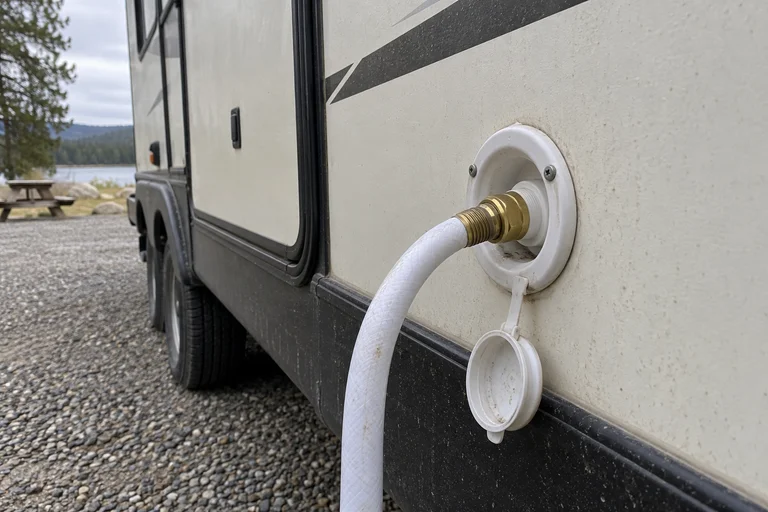
The shower barely rinses on the campground hookup, but water flows normally when you use the fresh tank and onboard pump. That comparison is more useful than a guess about the faucet or a shopping list of replacement parts.
It points toward the supply route used only by city water. The pump has already shown that the fixtures can deliver a better stream under another operating condition. It hasn't proved that every pipe is perfect, but it gives the diagnosis a place to start.
Make the comparison at the same faucet
Use the same cold-water faucet, opened to the same position, with other fixtures closed. Comparing a kitchen faucet on the pump with a shower on city water introduces another variable. Keep the pump off during the city-water observation so it doesn't help supply the fixture and hide the symptom.
If your owner's manual permits the comparison, shut off the campground supply and select normal tank-and-pump operation using the documented controls. The fresh tank needs an adequate supply of potable water. Don't improvise valve positions or run a pump with an empty tank.
Write down whether the improvement is immediate and sustained. A brief strong burst followed by a trickle is different from steady usable flow. Also note whether the problem began at this campsite or followed a filter change, winterization, or plumbing work.
Pressure on a gauge isn't the same as flow at the sink
Pressure describes the force available; flow describes how much water arrives over time. An acceptable gauge reading with all faucets closed doesn't establish that enough water can pass through the hookup while a faucet is open.
Winnebago's regulator comparison discusses both pressure control and delivered flow. A regulator has to protect the plumbing while allowing useful flow. Turning an adjustment upward without knowing the RV's limit isn't a diagnosis.
A technician can compare pressure under demand at useful points along the supply route. A pressure drop across a component while water moves helps locate a restriction. Gauge location matters: a gauge upstream of a clogged filter cannot tell you what pressure remains downstream.
Look along the hookup before opening cabinets
Walk the visible hose route. Look for a kink at the storage reel, a tight bend behind the trailer, or a hose compressed by equipment. Confirm that the campground faucet and your normal user-operated supply valves are set correctly. Check the RV's own panel instructions rather than borrowing another model's valve diagram.
The Heartland Owners Water Systems Guide identifies hoses, filters, regulators, and inlet screens as places where flow can be restricted. These are separate suspects, not reasons to replace everything together.
Inspect accessible equipment for damage and review filter service history. A change immediately after installing a cartridge warrants checking its part number and installation instructions. An old cartridge warrants inspection under its manufacturer's maintenance procedure. Neither observation proves the cartridge is the only problem.
Before loosening any water connection, turn off both water sources and relieve pressure through a cold faucet. Keep hose ends clean and away from sewer equipment. Leave pressurized housings, concealed plumbing, and anything requiring unfamiliar disassembly alone.
Don't remove protection to get a stronger shower
Keep the required pressure regulator in service. The Winnebago Voyage operator manual explains that city water supplies fixtures through a different route from the demand pump and recommends regulation to protect plumbing. Its settings and valve labels belong to that coach; use the limits for your own RV and connected equipment.
Don't force the inlet check valve open with a screwdriver, remove internal parts, or increase pressure until the shower feels right. If a regulator or inlet needs testing, the useful result is evidence that it restricts flow under the actual operating condition.
Ask campground staff whether there is a known supply problem, particularly if flow varies by time of day. A neighbor's report provides context, but their hose, regulator, and fixtures differ from yours. It doesn't clear your hookup or condemn the park supply by itself.
When the comparison points somewhere else
If only one fixture is weak on both sources, begin with that fixture's local path and its documented cleaning checks. If every fixture is weak on both sources, the original city-water-only diagnosis no longer fits. A shared restriction or another supply problem needs investigation.
Normal cold flow with weak hot flow is another distinct pattern. Record it rather than changing the regulator to compensate. The hot-water path includes additional equipment, and service may require cooling and isolating that equipment first.
If the fresh tank fills unexpectedly while connected to the hookup, use our guide to unintended fresh-tank filling. That symptom concerns water going to the wrong place. If the pump cycles with fixtures closed, our pressure-loss guide addresses that separate problem.
Bring the comparison to the service call
Send the RV model, photos of the hookup and water-control panel, filter and regulator details, and which fixtures were affected. Include the same-faucet city-versus-pump result. Those observations help a technician choose where to measure instead of starting with parts replacement.
Stop using the supply if you find a leak or unexplained water inside the RV. For persistent weak flow, our mobile RV plumbing repair service can investigate the supply route and installed components. Request service with your location and what changed between the two water sources.